
Quality, Audit and Compliance Management
8D problem solving and CAPA
A method that closes a non-conformity in eight steps with a team, containment, root cause and permanent action.
- Level:
- Practitioner
- Who it is for:
- Quality engineer, Plant manager
Definition
8D is a structured problem-solving method that resolves a non-conformity in eight steps. A team is formed, the problem is described and containment protects the customer. The root cause is found and verified, and a permanent action is chosen, applied and measured. In the seventh step the change that prevents recurrence goes into the standard and similar processes. In the eighth step the team's work is recognised and the record is closed.
When does it help?
- There is a customer complaint or a recurring quality problem.
- The cause is unknown and the problem spans several departments.
- Your customer wants the closure as a documented report.
When does it not help?
- It is a small issue with a known cause that one person can fix straight away; a short action is enough.
- No team can be formed; 8D then becomes a form one person fills in and loses its value.
Step-by-step method
Form the team (D1)
Form a small team of people who know the problem, can reach the data and can decide.
Describe the problem (D2)
Write the problem in measurable terms: what, where, when and how much.
Contain it (D3)
Take an action that protects the customer until the root cause is found, and check that it works.
Find and verify the root cause (D4)
List causes with 5 Whys or a fishbone; verify the most likely one with data.
Choose the permanent action (D5)
Choose the action that removes the verified root cause; check beforehand that it causes no unwanted effect.
Apply the permanent action (D6)
Apply the action, lift the containment and follow its effectiveness with data for a set period.
Prevent recurrence (D7)
Carry the change into the instruction, the control plan and similar processes.
Recognise the team and close (D8)
Share what was learned, recognise the team's work and close the record.
Example scenario
A burr complaint from a customer
A customer reports burrs on delivered parts. The team first sorts the parts in stock and puts shipments under control. A 5 Whys session shows that the die maintenance interval was not updated for the production volume. The maintenance plan is changed and the next shipments are followed with an extra check for a while.
A fictional example; the people, company and numbers are not real.
Common mistakes
- Mistaking containment for the permanent action.
- Writing "operator error" as the root cause and stopping; the question should be why the process allowed it.
- Closing the record without an effectiveness check.
Templates
8D report
D0 to D8: emergency action, team, problem description, containment, root cause, permanent action, prevention and closure.
Corrective action (CAPA) form
Non-conformity, immediate correction, root cause, a corrective action table and an effectiveness check.
5 Whys worksheet
Five "why?" rows with an evidence line each; root cause, measure table and a 30-day check.
Fishbone diagram
A blank 6M fishbone (man, machine, material, method, measurement, environment) with a most-likely-causes table.
A3 report
Background, current state, target, root cause, countermeasures, plan and follow-up on one landscape page.
Lessons
- The eight steps of 8D
The order of the eight steps, the output of each and which step must not be skipped.
1 min
- Finding and verifying the root cause
Listing causes with 5 Whys and a fishbone, then testing the most likely one with data.
1 min
- 8D field guide: the first meeting
Preparing the first 8D meeting, the agenda and what should come out of it.
Field guide
How does it work in Gemy on the floor?
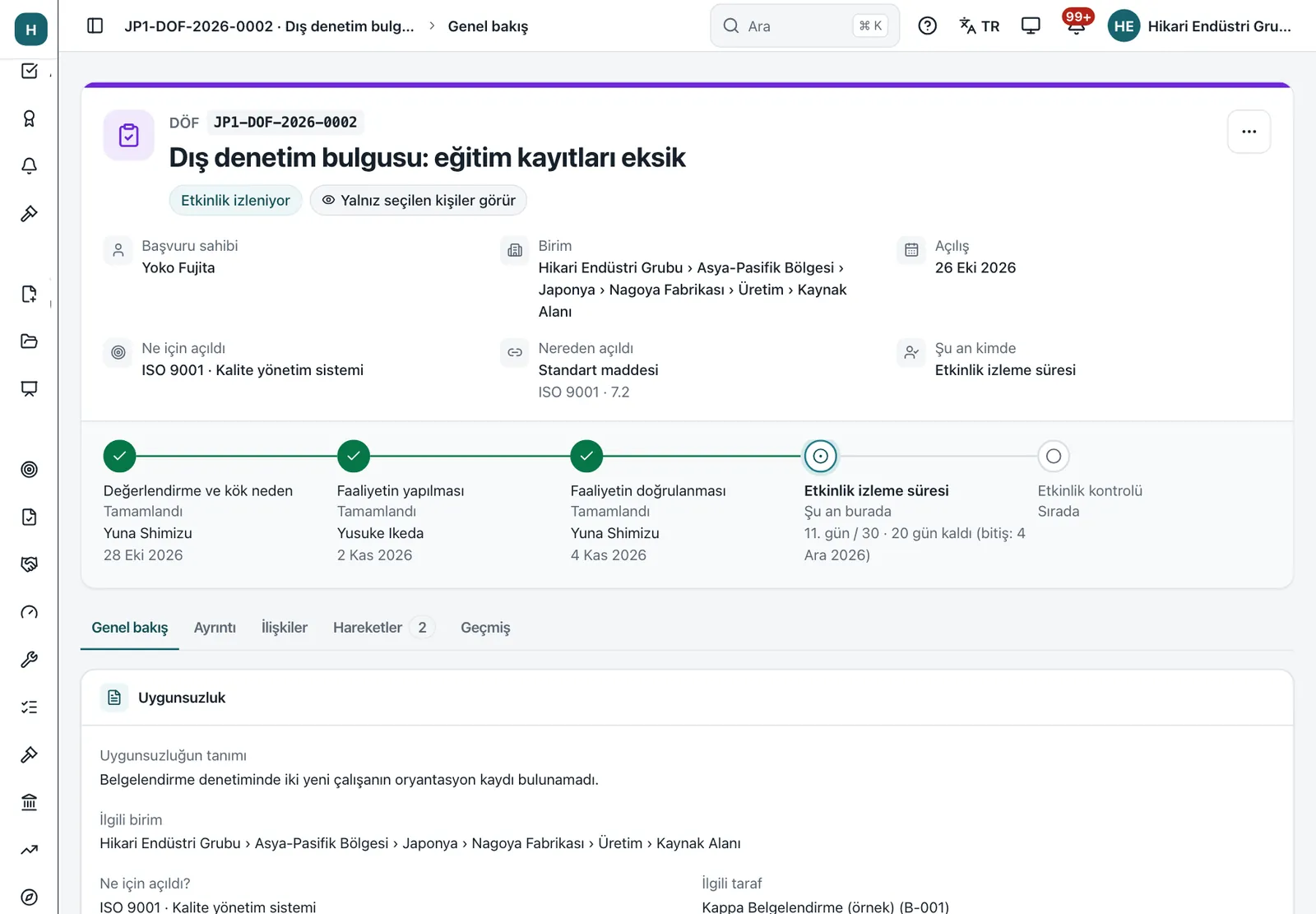
A CAPA record keeps the non-conformity, the 5 Whys and fishbone work, the actions and the effectiveness check together. 8D comes as a ready record type in the ready packages, and it can also be added on its own. The company can change its steps. Each root cause gets an action with an owner and a due date, and the evidence needed to close it is a company setting. In the ready CAPA type the person who opened the record checks effectiveness; barring people from verifying their own action is a company setting.
Terms
Sources
- EA23-002 Attachment, Request 16: Global 8D (G8D) disciplines D0–D8 (Ford Motor Company response). Opens in a new tab (PDF), U.S. National Highway Traffic Safety Administration (NHTSA) (accessed 15 November 2026)
- 5 Whys, Lean Enterprise Institute (accessed 15 November 2026)