
Lean Manufacturing and Continuous Improvement
Shortening changeovers with SMED
A method that reduces the time a machine stands still for a die or product change by separating, moving out and shortening steps.
- Level:
- Practitioner
- Who it is for:
- Shift supervisor, Lean and OPEX specialist, Maintenance and calibration lead
Definition
SMED is a method for shortening die or product changeovers, known from the work of Shigeo Shingo. Each changeover step is put into one of two groups. An internal step can only be done while the machine is stopped; an external step can be done while it runs. The method takes external steps out of the stoppage, tries to turn internal steps into external ones and shortens the internal steps that remain. Changeover time is the time from the last piece of the completed run to the first good piece of the new run.
When does it help?
- Die or product changeovers are near the top of the availability loss in OEE.
- You run larger batches and build stock because changeovers take long.
- Different shifts do the same changeover in different times.
When does it not help?
- The line changes over very rarely; if the loss is elsewhere, look there first.
- The real loss is not the changeover itself but adjusting the first parts of the new product; then study the process settings.
Step-by-step method
Record the changeover
Video one changeover from start to finish and list the steps with their times.
Separate internal and external
Ask of each step: can it be done while the machine runs? If so, it is external.
Take external steps out of the stoppage
Finish preparing tools, dies, material and documents before the machine stops.
Turn internal steps into external
Move internal steps outside through preheating, intermediate fixtures or preset settings.
Shorten the remaining internal steps
Cut the time with quick fasteners, positioning without adjustment and parallel work.
Make the new changeover the standard
Write the sequence, who does what and the checklist; teach it to the team and keep measuring.
Example scenario
A die change on a press line
On a press line the team videos one die change and lists the steps. Fetching the new die from the store and looking for bolts happen while the machine is stopped. The team gathers this preparation on a cart and finishes it before the stop. The die clamping points are set to the same height and the new sequence goes on a checklist.
A fictional example; the people, company and numbers are not real.
Common mistakes
- Starting without measuring; afterwards nobody can show what got shorter.
- Skipping safety steps to save time; cutting and isolating energy stay internal steps.
- Not writing down the new sequence; the shorter time slips back after a shift or two.
Related measure and calculator
Split the changeover steps into internal and external; see how much the stoppage shrinks when steps move out, get shorter or go.
Templates
SMED observation form
Changeover steps with durations; internal and external, target and idea columns, internal and external totals and the gain.
Lessons
- Separating internal and external setup
Measuring the changeover, putting each step into internal or external and taking external steps out of the stoppage.
1 min
- Tying the shorter changeover to the standard
Shortening internal steps, writing the new sequence as standard work and following the time.
1 min
- SMED field guide: the first changeover analysis
Preparing the first SMED analysis, recording the changeover and what you should have at the end of it.
Field guide
How does it work in Gemy on the floor?
Company switches onThis module is off in a new company; your administrator switches it on from the Features screen.
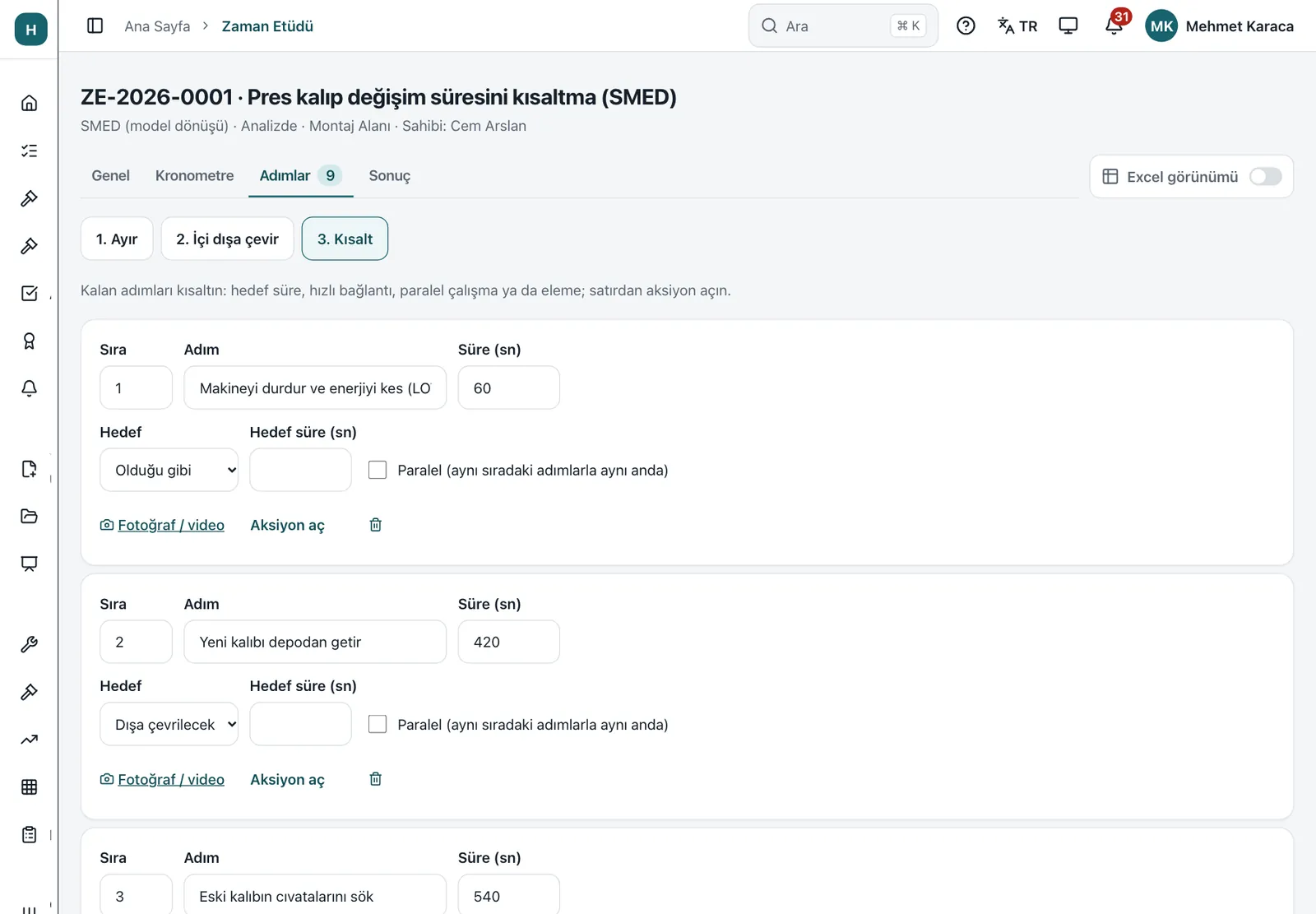
In a time study the changeover steps are timed with the field stopwatch and each step is marked internal or external. The separate, convert and streamline stages are handled one by one. Today's stoppage is the sum of the internal steps; the target stoppage and the saving are calculated on the same screen. For steps done in parallel, the longest one counts in the total. An action can be opened from a step, and a video can be added to it.
Condition: Switched on by the company.
Terms
Sources
- Single Minute Exchange of Die, Lean Enterprise Institute (accessed 16 November 2026)
- Shigeo Shingo, A Revolution in Manufacturing: The SMED System. Productivity Press, 1985. ISBN 9780915299034.
- Changeover, Lean Enterprise Institute (accessed 16 November 2026)
- Standardized Work, Lean Enterprise Institute (accessed 16 November 2026)