
Health, Safety, Environment and Sustainability
Risk assessment with 5×5 and Fine-Kinney
Team work that finds workplace hazards on the floor, scores them, reads them against a written threshold and ties each risk to a control.
- Level:
- Practitioner
- Who it is for:
- Safety specialist, Shift supervisor, Plant manager
Definition
Risk assessment is team work that finds workplace hazards, scores how much harm each can cause and ties it to a control. This topic covers two scoring methods. In a 5×5 matrix, likelihood and severity are scored from one to five and multiplied. In the Fine-Kinney method, probability, frequency of exposure and severity are multiplied; the scale steps are not evenly spaced. In both methods the score is a ranking tool; the written threshold and the control make the decision.
When does it help?
- You need to rank hazards before a new machine, line or job starts.
- You are renewing the assessment after a work accident, an occupational disease or a near miss.
- The team has to decide which control gets resources first.
When does it not help?
- Proving that a single hazard is acceptable; the score is a ranking, not a measurement.
- As the only basis for a measurable factor such as noise, dust or a chemical; that needs a workplace measurement.
Step-by-step method
Form the team
Work with the employer or their deputy, the safety specialist, the workplace doctor, the employee representative, the support staff and workers who know the job.
List the area and the jobs
Split the area into parts; for each part write the jobs done and the machines used.
Find hazards on the floor
Walk the area with the team; add event and near-miss records, maintenance notes and what workers tell you.
Score
Give each row two scores with the method the company chose. First score the raw risk as if no control were in place, then the residual risk with today's controls. Everyone should read the scale definitions the same way.
Choose the control by the hierarchy
Think first of removing the hazard, then substituting it, then engineering and administrative controls; personal protective equipment is the last rung.
Assign an owner and score again
Give each control an owner and a due date; once the control is in place, score the row's residual risk again.
Keep it in writing and renew it
Record the assessment; renew it after changes, after an event and within the period the hazard class requires.
Example scenario
Assessing a new turning cell
In a machining workshop the team walks the area before a new turning cell goes live. Chip spatter, contact with the rotating chuck and skin contact with coolant are written down as hazards. Contact with the rotating chuck gets the highest score; the control column holds only a warning sign. The team adds an interlocked guard that stops the machine when the door opens and scores the row again once the guard works.
A fictional example; the people, company and numbers are not real.
Common mistakes
- Writing the assessment at a desk; a team that does not walk the floor never sees some of the hazards.
- Moving the threshold after seeing the score; the threshold is written before scoring.
- Putting only training and personal protective equipment in the control column; the hazard stays where it is.
- Lowering the score because a control is planned; the score is given again once the control is in place.
Related measure and calculator
Pick likelihood and impact (and frequency for Fine-Kinney); see the score, the level and which threshold set it.
Templates
Risk assessment table (5×5)
Hazard, likelihood and severity 1–5, a calculated score, level by your company's thresholds and extra controls; for preliminary use.
Lessons
- Finding and writing down hazards on the floor
Telling a hazard from a risk, walking the area with the team and writing each hazard as a row that can be scored.
1 min
- Reading the score, the threshold and the control
Calculating the 5×5 and Fine-Kinney score, writing the threshold in advance and choosing the control by the hierarchy of controls.
1 min
- Risk assessment field guide: walking one area
Preparing the risk assessment of one area, the steps of the walk on the floor and what you should have at the end of it.
Field guide
How does it work in Gemy on the floor?
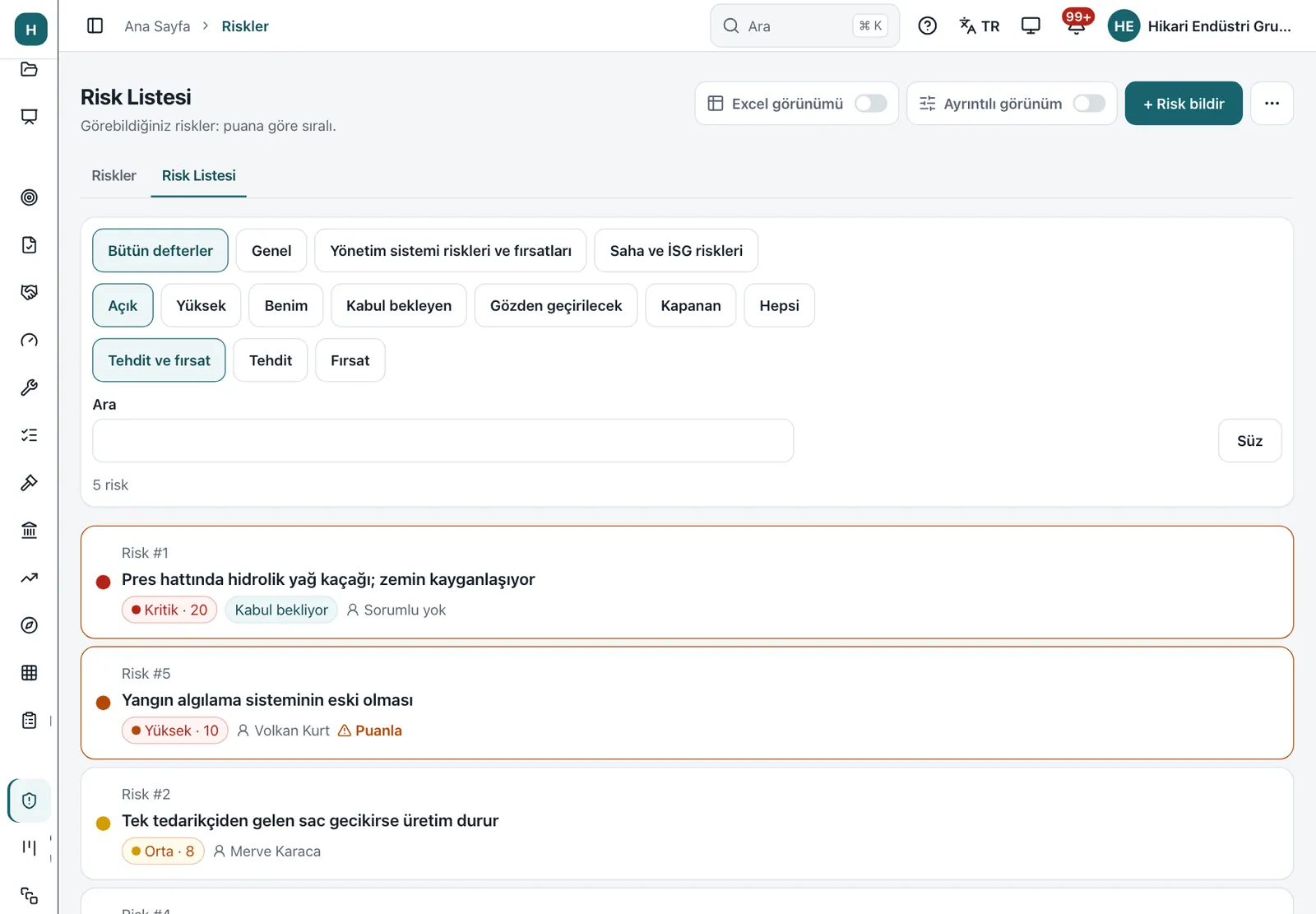
The company chooses the scoring method in the settings: 3×3, 5×5, Fine-Kinney or its own scale. The scale steps and level thresholds are company data; the ready Fine-Kinney scale comes with four levels. Each risk keeps two scores separately, and the formula is shown on screen. The "Before controls" score shows the raw (inherent, initial) risk before existing or additional measures are taken into account. The "After controls" score shows the residual risk that remains once the existing controls are in place. When an action opened from a risk is closed, the risk owner is notified to reassess it. When a risk's review date comes, its owner gets a reminder.
Terms
Sources
- İş Sağlığı ve Güvenliği Risk Değerlendirmesi Yönetmeliği (Resmî Gazete 29.12.2012, sayı 28512), T.C. Resmî Gazete (accessed 16 November 2026)
- 6331 sayılı İş Sağlığı ve Güvenliği Kanunu. Opens in a new tab (PDF), T.C. Cumhurbaşkanlığı Mevzuat Bilgi Sistemi (accessed 16 November 2026)
- Managing risks and risk assessment at work, Health and Safety Executive (HSE) (accessed 16 November 2026)
- Hierarchy of Controls, National Institute for Occupational Safety and Health (NIOSH) (accessed 16 November 2026)