
Quality, Audit and Compliance Management
Catching failures early with FMEA
Team work that writes down, line by line, what can go wrong in a process or design, scores it and ties it to prevention.
- Level:
- Practitioner
- Who it is for:
- Quality engineer, Plant manager
Definition
FMEA is failure mode and effects analysis: it looks ahead for possible failures in the steps of a process or the functions of a design. For each failure mode its effect, its cause and today's prevention and detection controls are written down. The failure is rated on the scales the company chooses, for example severity, occurrence and detection ratings. Action is taken on the priority rows, and each row is scored again after the action. IEC 60812 sets out the general framework of the method.
When does it help?
- Before a new process, product or machine goes live.
- When a significant change is about to be made to an existing process.
- When a customer or sector rule asks for a process FMEA and a control plan.
When does it not help?
- Finding the root cause of a problem that has already happened; 8D or 5 Whys suit that better.
- As a form one person fills in at a desk; without a team that knows the process, failure modes are missed.
Step-by-step method
Set the scope and the team
Which process or design, from where to where; form a small team of people who know the process.
Write the steps and functions
Map the process flow step by step; write what each step must do.
List the failure modes
For each step write what can go wrong, its effect and its cause.
Write today's controls
Write the control that prevents the failure and the control that catches it separately.
Score and read the priority
Score severity, occurrence and detection on the company's scale; read the priority by the company's rule.
Act and score again
Give each priority row an action with an owner and a due date; score the row again once the action is done.
Example scenario
A process FMEA in a welding cell
Before a new welding cell goes live the team runs a process FMEA. A missing weld seam is written down as a failure mode; its effect is a joint that breaks at the customer. Its cause is the part being loaded the wrong way into the fixture, so the seam lands in the wrong place. Today's only control is a visual check at the end of the shift. The team adds a pin that stops the part being loaded the wrong way into the fixture and scores the row again.
A fictional example; the people, company and numbers are not real.
Common mistakes
- Looking only at the risk priority number; a high-severity failure can slip through with a low number.
- Putting detection in place of prevention; inspection finds the failure but does not stop it from happening.
- Not scoring again after the action; nobody can see whether the action worked.
Templates
FMEA table
Failure mode, effect, cause, prevention and detection controls; S, O, D scores on your own scale and an optional product.
Lessons
- Setting the FMEA team and scope
Drawing the boundary of the study, forming the team and taking the rows from the process flow.
1 min
- From FMEA to prevention and the control plan
Separating prevention from detection, choosing a mistake-proofing device and linking the row to the control plan.
1 min
- FMEA field guide: the first working session
Preparing the first FMEA session, the steps of the session and what you should have at the end of it.
Field guide
How does it work in Gemy on the floor?
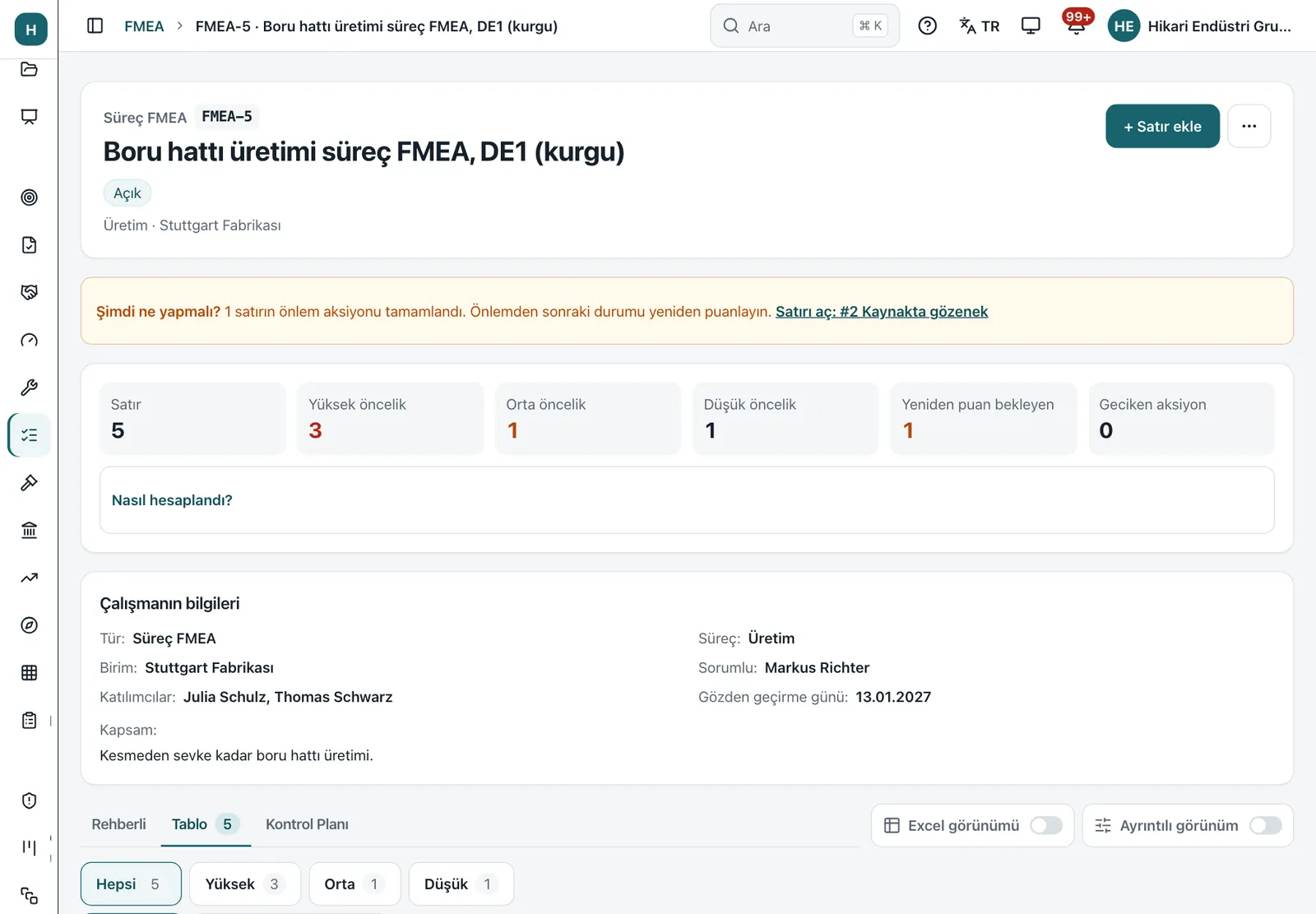
An FMEA study is linked to a process or a product; each row holds the failure mode, effect, cause and the prevention and detection controls. Priority is read by the method the company chooses: RPN thresholds or an action priority table the company fills in itself. The action opened from a row is followed in the action list. When the action is done the row is scored again, and the score history is not deleted. The study's control plan tab holds the characteristic, control method, frequency and reaction plan.
Terms
Sources
- IEC 60812:2018 Failure modes and effects analysis (FMEA and FMECA), International Electrotechnical Commission (IEC) (accessed 16 November 2026)
- Poka Yoke, Lean Enterprise Institute (accessed 16 November 2026)