
Health, Safety, Environment and Sustainability
From incident report to root cause
Taking an incident or near-miss report, investigating it and reaching the root cause that prevents a repeat.
- Level:
- Introductory
- Who it is for:
- Safety specialist, Shift supervisor
Definition
Incident investigation is the work of finding out what happened after an accident or near miss, why it happened and what will prevent a repeat. A good investigation looks for the conditions that allowed the event, not for a person to blame. The easier it is to report, the more hazards become visible before an accident happens.
When does it help?
- An accident, near miss or hazardous condition has been reported.
- Events of the same kind repeat across shifts.
- You want to see whether the measures taken are working.
When does it not help?
- The investigation is run to find someone to blame; people stop reporting.
- It is used in place of a legal reporting duty; the official notification is made separately and on time.
Step-by-step method
Make the area safe
Look after anyone injured and stop the hazard first; the investigation starts only when the area is safe.
Take the report
Take a short report on what happened, where, and what could have happened; add a photo.
Gather information
Talk to witnesses, examine the area and equipment, collect the relevant instructions and records.
Reach the root cause
Start from the direct cause and keep asking why; look for the gap in the system.
Choose and follow the measure
Assign a measure that targets the root cause with an owner and due date; follow its effect for a set period.
Example scenario
A near miss at a forklift crossing
An employee reports a forklift entering a pedestrian crossing fast at the warehouse exit. The investigation shows that a tall rack at the corner blocked the view. The rack is moved, a mirror is fitted at the corner and shift supervisors watch the crossing for a month.
A fictional example; the people, company and numbers are not real.
Common mistakes
- Closing the investigation with "carelessness" as the finding.
- Treating near-miss reports as minor and not investigating them.
- Writing the measure down and never checking its effect.
Related measure and calculator
Frequency and severity rates from accidents, lost days and hours worked; the multipliers are shown and can be changed.
Templates
Near-miss report form
What happened, what could have happened, immediate action; EHS review, root cause and permanent measure.
5 Whys worksheet
Five "why?" rows with an evidence line each; root cause, measure table and a 30-day check.
Lessons
- A good incident report
What a report should contain and why people stop reporting.
1 min
- Root cause in incident investigation
Moving from the direct cause to the gap in the system and not stopping at human error.
1 min
- Incident investigation field guide
What the investigation team does in the first hours after an event, and what the investigation produces.
Field guide
How does it work in Gemy on the floor?
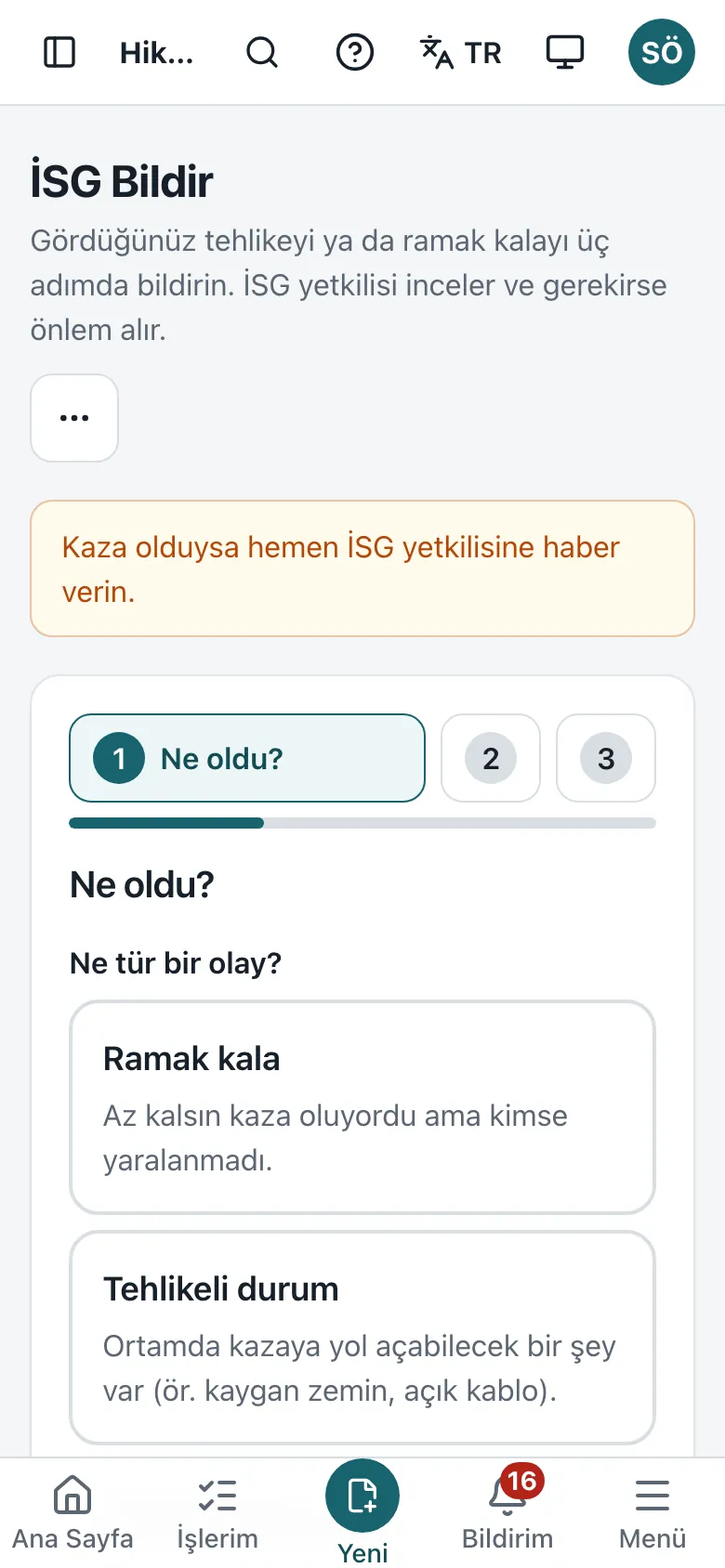
Incidents, near misses and hazards are reported from a phone with type, place and photo; a staff number and PIN are enough. Investigation, root cause and actions move on the same record. Accident-free days and accident rates show on the board. Health data sits in a separate vault open only to the authorised health role.
Terms
Sources
- Incident Investigation, Occupational Safety and Health Administration (OSHA) (accessed 15 November 2026)
- Human factors in accident investigations, Health and Safety Executive (HSE) (accessed 15 November 2026)