
Strategy, Performance and Corporate Governance
From claimed to verified savings
Keeping an improvement's gain apart from the estimate, measuring it against a set baseline, having another person verify it and checking that it lasts.
- Level:
- Practitioner
- Who it is for:
- Strategy and planning lead, Plant manager, Lean and OPEX specialist
Definition
A verified saving is the gain from an improvement calculated by measurement rather than by estimate, and then approved. A saving cannot be measured directly, because it describes consumption that did not happen. That is why the baseline before the change is compared with the period after it, and differences in conditions are adjusted. EVO's IPMVP protocol writes the rules of this comparison for energy and water projects.
When does it help?
- Improvement gains are to be reported to management or finance.
- A reward or recognition depends on the size of the gain.
- The gain is to be written into the budget or the plan.
When does it not help?
- There is no data to measure the gain and it cannot be collected; the gain stays an estimate and is written as one.
- Weighing a safety control by financial gain alone; the control may be needed even if no gain comes out.
Step-by-step method
Choose the type of gain
Cash savings, time and productivity, and avoided cost are separate types; give each claim one type.
Write the baseline and method first
Before the change, write which measure, which period and which unit cost will be used.
Open the measurement period
After the change, collect the same measure in the same way.
Adjust for differences in conditions
If output or product mix changed, bring the comparison to the same basis.
Give verification to someone else
The person who wrote the claim does not approve their own gain; finance or an authorised person decides.
Keep estimate and verified apart
Report the two amounts side by side; do not merge them into one total.
Measure again to see if it lasts
Repeat the same measurement on set days and look at how much of the gain is kept.
Example scenario
The gain from a Kaizen that cut scrap
In a plastic injection shop the Kaizen team proposes changing a mould setting and writes the yearly gain down as an estimate. Before the change, the quality engineer writes down the baseline: scrap per unit over the previous three months. The three months after the change are compared by scrap per unit on the same products. The finance lead calculates the amount with the material cost per kilogram and verifies it; the measurement is repeated six months later.
A fictional example; the people, company and numbers are not real.
Common mistakes
- Reporting an estimate as if it were verified; management decides on a gain that does not exist.
- Merging cash savings, time and avoided cost into one total; the total describes neither money nor time.
- Choosing the baseline after measuring; a baseline chosen afterwards pulls the gain to the size you want.
- Turning the first month's gain into a yearly figure without checking that it lasts; an improvement that slipped back stays in the report.
Lessons
- Measuring and verifying a claimed saving
Writing the baseline and method in advance, adjusting for changed conditions, giving verification to someone else and checking that the gain lasts.
1 min
How does it work in Gemy on the floor?
Company switches onThis module is off in a new company; your administrator switches it on from the Features screen.
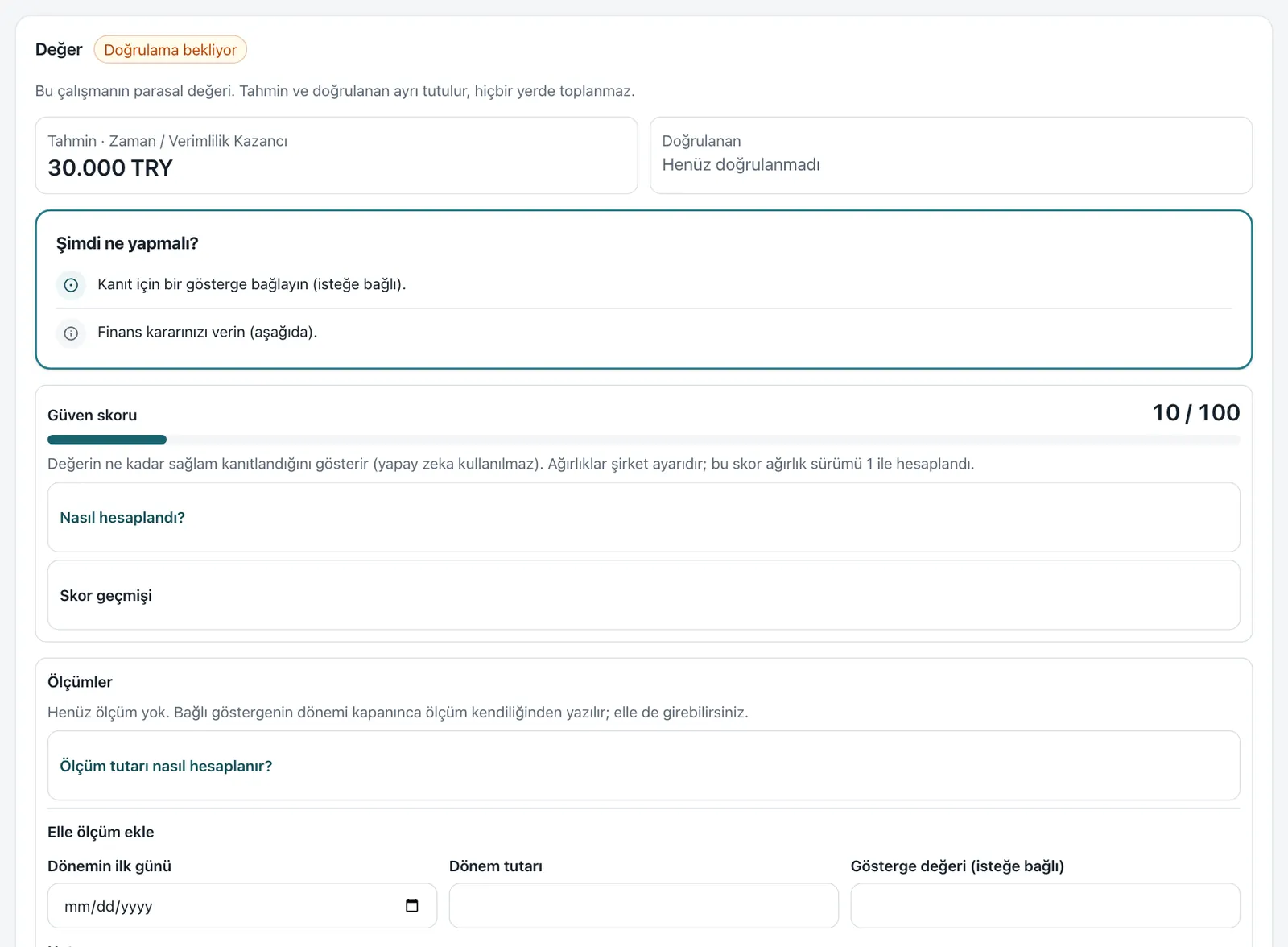
A value claim is opened from a record, an action, a Kobetsu study or a time study. Cash savings, time and productivity, and avoided cost are shown separately and never merged into one total. The estimate and the verified amount are kept apart and not added together. Measurements come in by hand, from an indicator or through an integration. The finance decision is to verify, send back for correction or reject, and a person cannot verify their own claim. If the verified amount differs from the estimate by more than the limit the company set, a reason is required. Retention is measured again on the days in the settings; the ready days are 30, 90, 180 and 365. The share kept is read against two thresholds the company sets. If there is no measurement in the window, the result counts as insufficient data, not as a loss.
Condition: The company switches it on; measurement, finance verification, the confidence score and retention tracking are switched on with separate keys.
Terms
Sources
- IPMVP (International Performance Measurement and Verification Protocol), Efficiency Valuation Organization (EVO) (accessed 16 November 2026)
- Measurement and Verification for Federal Energy Savings Performance Contracts, U.S. Department of Energy, Federal Energy Management Program (FEMP) (accessed 16 November 2026)