
People, Competence and Organisational Continuity
One point lessons and training impact
A short lesson that teaches one piece of floor knowledge on one page, and seeing whether training really shows up in the work.
- Level:
- Introductory
- Who it is for:
- Shift supervisor, HR and training lead, Lean and OPEX specialist
Definition
A one point lesson is short training material that explains one topic on one page, with visuals. A piece of knowledge, a breakdown or an improvement is written so that it can be read in a short time. Training impact is how far what was learned shows up in the work. The four levels described by Donald Kirkpatrick split this into reaction, learning, behaviour and results.
When does it help?
- A breakdown or defect keeps coming back, and everyone on the floor needs to know the fix.
- An improvement was made and you need to teach the new method the same way to every shift.
- You want to show a new worker one critical point of the job, briefly and visually.
When does it not help?
- Describing the whole sequence of a job; that belongs in a work instruction or standard work.
- Replacing training that the law sets in length and content; a one point lesson adds to it but does not replace it. Article 17 of Law No. 6331 requires occupational health and safety training; the training regulation of 2 April 2026 sets its length and topics.
Step-by-step method
Choose one topic
Pick a breakdown, a setting or a quality point; a second topic is a second lesson.
Explain it with visuals
Show the right and wrong state side by side in a photo or drawing; keep the text short.
Try it on the floor
Read the lesson with someone who does the job and fix the part they did not understand.
Reach the target people
Write who should read the lesson and record that they read and understood it.
Watch for it in the work
After a set time, watch the job on the floor or ask the person's supervisor.
Tie the result to a measure
Look at the count of the defect or stop the lesson targets, before and after the lesson.
Example scenario
A recurring jam on a packaging line
On a packaging line the same jam on the film wrapping machine comes back every week. The maintenance lead prepares a one point lesson that shows the right and wrong film path in two photos. The lesson is read with the operators of all three shifts, and their reading is recorded. The next month the shift supervisor compares the jam records with the month before and writes the result on the lesson record.
A fictional example; the people, company and numbers are not real.
Common mistakes
- Fitting several topics onto one page; the reader cannot tell what matters.
- Treating a read lesson as the end of training; reading does not show that it was learned or applied.
- Calling a lesson effective without measuring; if the defect count did not change, the lesson did not reach the work.
- Leaving an outdated lesson on the board; when the method changes, the lesson is updated or removed.
Templates
One point lesson
One topic on one page: lesson type, a one-sentence message, a large picture area, right and wrong, and who took the lesson.
Lessons
- Writing a good one point lesson
Choosing one topic for the lesson, building the page around visuals, and trying the lesson on the floor and keeping it current.
1 min
- Seeing training show up in the work
Telling apart the four levels of training, asking the person and the manager separately about the job, and showing the result as before and after.
1 min
How does it work in Gemy on the floor?
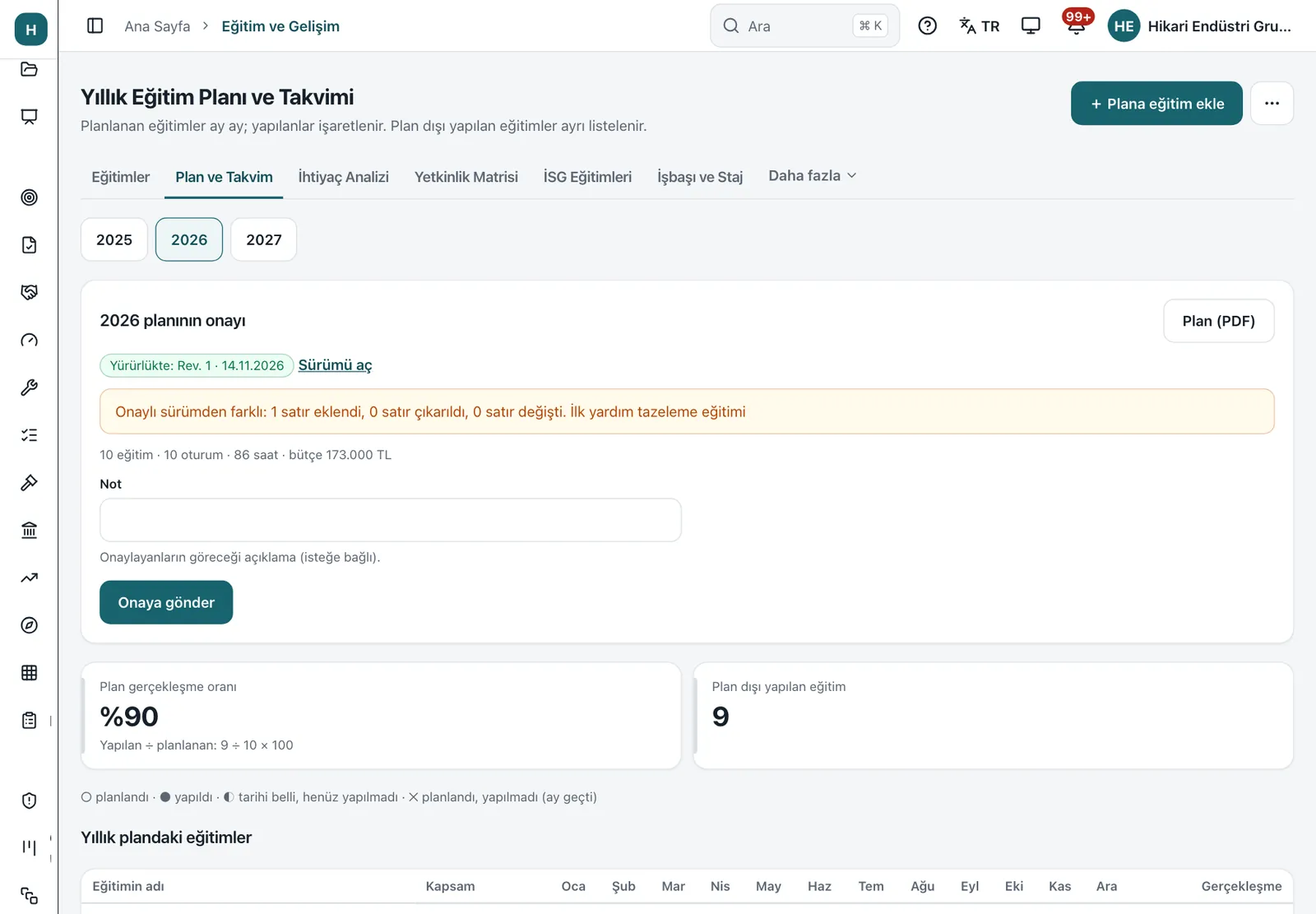
The training plan, needs analysis, exams and forms are structures the company sets up. The training page sums up effectiveness at four levels: satisfaction, exam, transfer to the job and result indicator. The job transfer form opens a set number of days after the training, separately for the person and their first-line manager. People whose manager says retraining is needed, and people who failed the exam, are listed as suggestions in the needs analysis. A result indicator is entered by hand with its before and after values.
Terms
Sources
- Safety Management: Education and Training, Occupational Safety and Health Administration (OSHA) (accessed 15 November 2026)
- What is competence?, Health and Safety Executive (HSE) (accessed 15 November 2026)
- Donald L. Kirkpatrick, Evaluating Training Programs: The Four Levels. Berrett-Koehler, 1994.
- What is The Kirkpatrick Model?, Kirkpatrick Partners (accessed 16 November 2026)
- Standardized Work, Lean Enterprise Institute (accessed 16 November 2026)
- Visual Management, Lean Enterprise Institute (accessed 16 November 2026)
- 6331 sayılı İş Sağlığı ve Güvenliği Kanunu. Opens in a new tab (PDF), T.C. Cumhurbaşkanlığı Mevzuat Bilgi Sistemi (accessed 16 November 2026)
- Çalışanların İş Sağlığı ve Güvenliği Eğitimlerinin Usul ve Esasları Hakkında Yönetmelik (Resmî Gazete 2.4.2026, sayı 33212), T.C. Resmî Gazete (accessed 16 November 2026)