
Lean Manufacturing and Continuous Improvement
The gemba walk
A regular floor visit: a manager goes where the work is done, sees the situation, asks questions and ties findings to actions.
- Level:
- Introductory
- Who it is for:
- Shift supervisor, Plant manager, Lean and OPEX specialist
Definition
Gemba is Japanese for the actual place: the line, workbench or warehouse where value is created. On a gemba walk a manager observes the situation on site and asks questions before deciding anything. The walk rests on the principle of seeing for yourself, known as genchi genbutsu. A walk is not an audit; the aim is to understand how the work runs today, not to score anyone.
When does it help?
- The numbers in reports and what people say on the floor do not match.
- A problem is discussed in meetings, but nobody has seen it on site.
- You want to see how a new standard is applied on the floor.
When does it not help?
- Catching one person's mistake; if the walk turns into a search for blame, nobody shows you problems.
- Scoring compliance with a rule; that belongs in a 5S audit or a layered audit.
Step-by-step method
Choose the aim and the area
Write in one sentence what the walk will look at; one area, one flow or one problem is enough.
Prepare the question list
Write short, open questions for safety, quality, cost and delivery.
Observe on site
Watch the work quietly for a while; look at the part, the measurement and the board.
Ask the person doing the job
Ask why it is done this way; do not give the solution, listen to the answer.
Write down what you see
Keep observation apart from opinion; note the place, the time and the count.
Tie it to an action
Give each problem an owner and a due date; note the rest for the next walk.
Close the loop
On the next walk, check what the earlier actions changed on site.
Example scenario
Crates waiting on an assembly line
On a home appliance assembly line, the production manager goes on the weekly walk with a question list. The manager sees full crates waiting at the head of the line and asks the operator why. The operator explains that the feeding cart comes twice a shift and the crates take up space. The manager does not give a solution, but gives the logistics lead an action to study the feeding frequency. The result is checked on the next walk.
A fictional example; the people, company and numbers are not real.
Common mistakes
- Turning the walk into a round of handing out solutions; the team stops thinking and waits for you next time.
- Walking without a question list; the eye looks at what it is used to.
- Leaving a problem without an action; the team will not show you the same problem on the next walk.
- Saving walks for days that go well; problems show up on the hard shift.
Templates
Gemba walk checklist
Twelve questions across safety, quality, cost, delivery, 5S and people; an observation-to-action table.
Lessons
- Preparing for a gemba walk
Choosing the aim of the walk, writing the question list, and using questions together with observation on the floor.
1 min
- From a gemba finding to an action
Writing observations apart from opinions, giving each problem an owner and a due date, and checking the result on the next walk.
1 min
- Gemba field guide: the first walk
Preparing the first gemba walk, the steps on the floor and what you should have at the end of it.
Field guide
How does it work in Gemy on the floor?
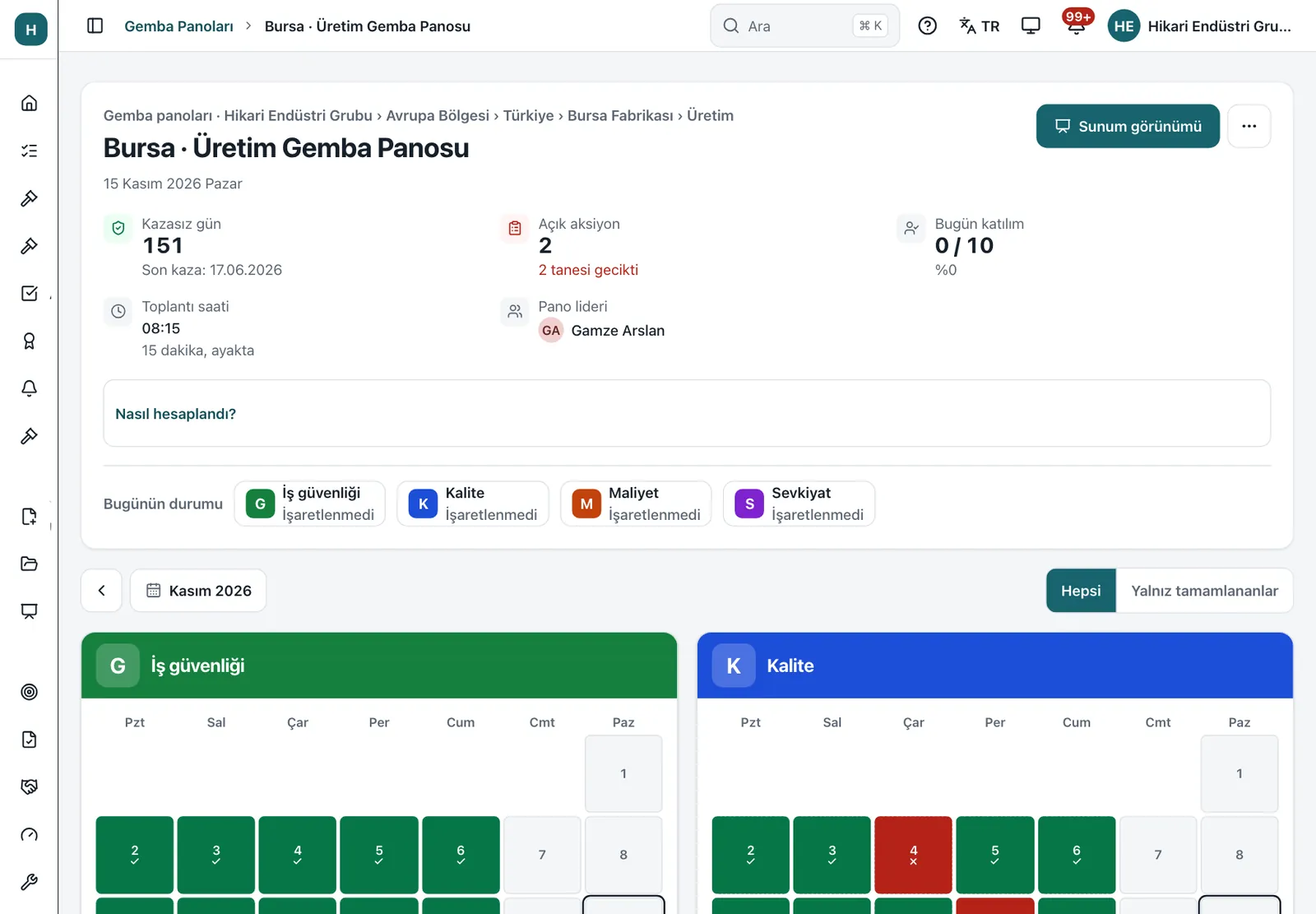
Each unit has a Gemba board; its columns and indicators are a layout the company sets up. On the SQCD calendar each day is marked good, attention or problem day. Indicators such as accident-free days and open actions come from the system. Attendance and notes of the daily meeting are written on the board. A problem seen in the meeting is opened as an action with an owner and a due date and followed on the action list. Boards of lower units roll up to the board above, and there is a presentation view for monitors. Print the walk list from the template on this page, and open a problem seen on the walk as an action on the board.
Terms
Sources
- Gemba, Lean Enterprise Institute (accessed 16 November 2026)
- Genchi Genbutsu, Lean Enterprise Institute (accessed 16 November 2026)
- Visual Management, Lean Enterprise Institute (accessed 16 November 2026)
- James P. Womack, Gemba Walks. Lean Enterprise Institute, 2011. ISBN 9781934109151.