
Lean Manufacturing and Continuous Improvement
The 5S workplace programme
A shop-floor programme that keeps the workplace visible through sort, set in order, shine, standardise and sustain.
- Level:
- Introductory
- Who it is for:
- Shift supervisor, Lean and OPEX specialist, Plant manager
Definition
5S is a shop-floor programme that organises the workplace in five steps: sort, set in order, shine, standardise and sustain. The aim is a work area where normal and abnormal can be told apart at a glance. Unneeded material leaves the area, the rest gets a place and cleaning turns into an inspection round. The rules are written down and kept alive with regular audits.
When does it help?
- You often lose time looking for tools, dies or documents.
- Leaks, loose connections or missing parts in an area are noticed late.
- New starters take a long time to learn the area.
When does it not help?
- It is treated as a one-off clean-up campaign; without audits the order often slips back.
- The problem is process design rather than workplace order; then look at the flow first.
Step-by-step method
Sort
Red-tag every item in the area that may not be needed for the work here, is in the wrong place or is there in excess.
Set in order
Give everything that stays a place; mark it, label it and keep frequently used items close.
Shine
Run cleaning as an inspection round; record any leak, wear or looseness you see.
Standardise
Describe the area's layout with photos and a short rule list so every shift sees the same picture.
Sustain
Set a regular audit calendar; post the score in the area and give findings to an owner with a due date.
Example scenario
The first month on an assembly line
On an assembly line the team spends the first week only on sorting and gathers red-tagged material in a separate zone. In the second week tool positions are drawn on a shadow board. The shift supervisor runs a short audit every Friday and findings go on the board with an owner and a due date.
A fictional example; the people, company and numbers are not real.
Common mistakes
- Using the audit to blame people; a finding should point at the area.
- Skipping the sort step and going straight to new shelves and labels.
- Measuring the score but leaving findings without an owner.
Templates
5S audit checklist
Five items per step, a 0–4 score column, step totals and an overall score out of 100.
Lessons
- Why 5S helps and where to start
What 5S changes on the floor and how to choose the first area.
1 min
- 5S audits and sustaining
Writing audit questions, reading the score and giving each finding an owner.
1 min
- 5S field guide: the first audit
Preparing the first 5S audit, the steps and what you should have at the end of it.
Field guide
How does it work in Gemy on the floor?
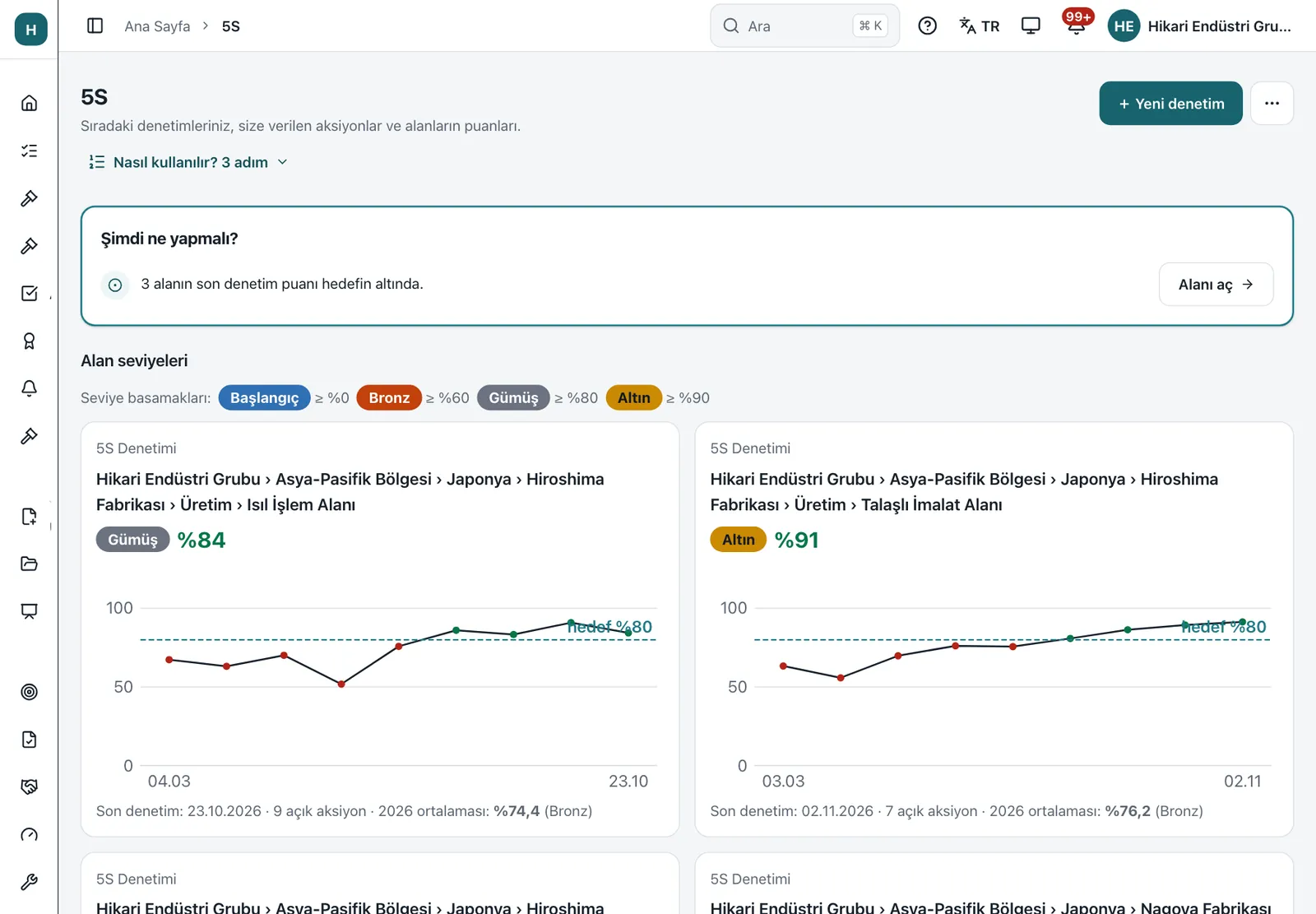
The auditor answers the 5S questions on a phone and takes photos. A non-conformity reaches its owner as an action with a due date; the evidence needed to close it is a company setting. Red tags are opened from the audit, and the area's 5S stage and score trend are followed on the same screen. The company sets up its own areas, questions and stages.
Condition: Offline audit answers are switched on by the company admin; completing an audit needs a connection.
Terms
Sources
- Lean Thinking and Methods: 5S, U.S. Environmental Protection Agency (accessed 15 November 2026)
- 5S, Lean Enterprise Institute (accessed 15 November 2026)