
Equipment, Fleet and Supplier Operations
Supplier evaluation and second-party audits
Scoring suppliers periodically against written criteria, auditing them on site where needed and setting up a development plan with the weak ones.
- Level:
- Practitioner
- Who it is for:
- Quality engineer, Plant manager
Definition
Supplier evaluation is selecting, monitoring and periodically re-scoring the providers of bought-in products and services against written criteria. ISO 9001 requires criteria to be set for evaluating, selecting and monitoring external providers. A second-party audit is an on-site review of a supplier by the customer, or by an auditor acting for the customer. ISO 19011 distinguishes first-, second- and third-party audits and gives guidance on how audits are carried out.
When does it help?
- The same supplier's defects keep coming back, and discussions rest on memory rather than records.
- A new supplier is to be selected and the candidates are to be compared on the same criteria.
- Purchasing, quality and production say different things about a supplier's state.
When does it not help?
- Auditing every supplier to the same depth for one-off, low-importance purchases; audit depth is chosen by risk.
- Punishing a supplier; the aim of the evaluation is a decision to continue, monitor or develop.
Step-by-step method
Choose who is evaluated
List the suppliers that affect product quality, delivery or safety.
Write the criteria and weights
Write criteria such as quality, delivery, documents and cooperation, and the weight of each.
Set where each score comes from
Decide in advance whether each criterion is counted from records or scored by the evaluator.
Define the classes and the response
Write which score range falls into which class and in which class an action is expected.
Plan on-site audits by risk
Audit on site the suppliers whose class drops or who deliver critical products.
Follow the development plan
Set up a plan with a due date with the supplier for the weak criterion, and check its result at the next evaluation.
Example scenario
A moisture problem at a granule supplier
At a home appliance parts maker, moisture in plastic granules from one supplier leads to three complaints in a quarter. The quality engineer makes complaint records a counted criterion in the evaluation, and the supplier's class drops. The on-site audit shows that drying time is applied differently from shift to shift. A plan with a due date for drying control is agreed with the supplier, and its result is read at the next evaluation.
A fictional example; the people, company and numbers are not real.
Common mistakes
- Scoring without written criteria; the same supplier gets different scores from different people.
- Using only manual scores; complaint and late delivery records stay out of the score.
- Changing a saved evaluation afterwards; past scores can no longer be trusted, so a correction is made with a new evaluation.
- Sending an audit finding to the supplier without following it up; the same finding comes back at the next audit.
Templates
Supplier evaluation card
Your own criteria and weights, 1–5 scores, a calculated weighted score, a check that weights total 100, and the decision.
Lessons
- Setting supplier criteria and the score
Writing the criteria and their weights, using scores counted from records alongside manual scores, and tying the score to a class.
1 min
- Supplier audits and development plans
Planning on-site audits by risk, running them with a scope and criteria, and turning findings into a development plan with due dates.
1 min
How does it work in Gemy on the floor?
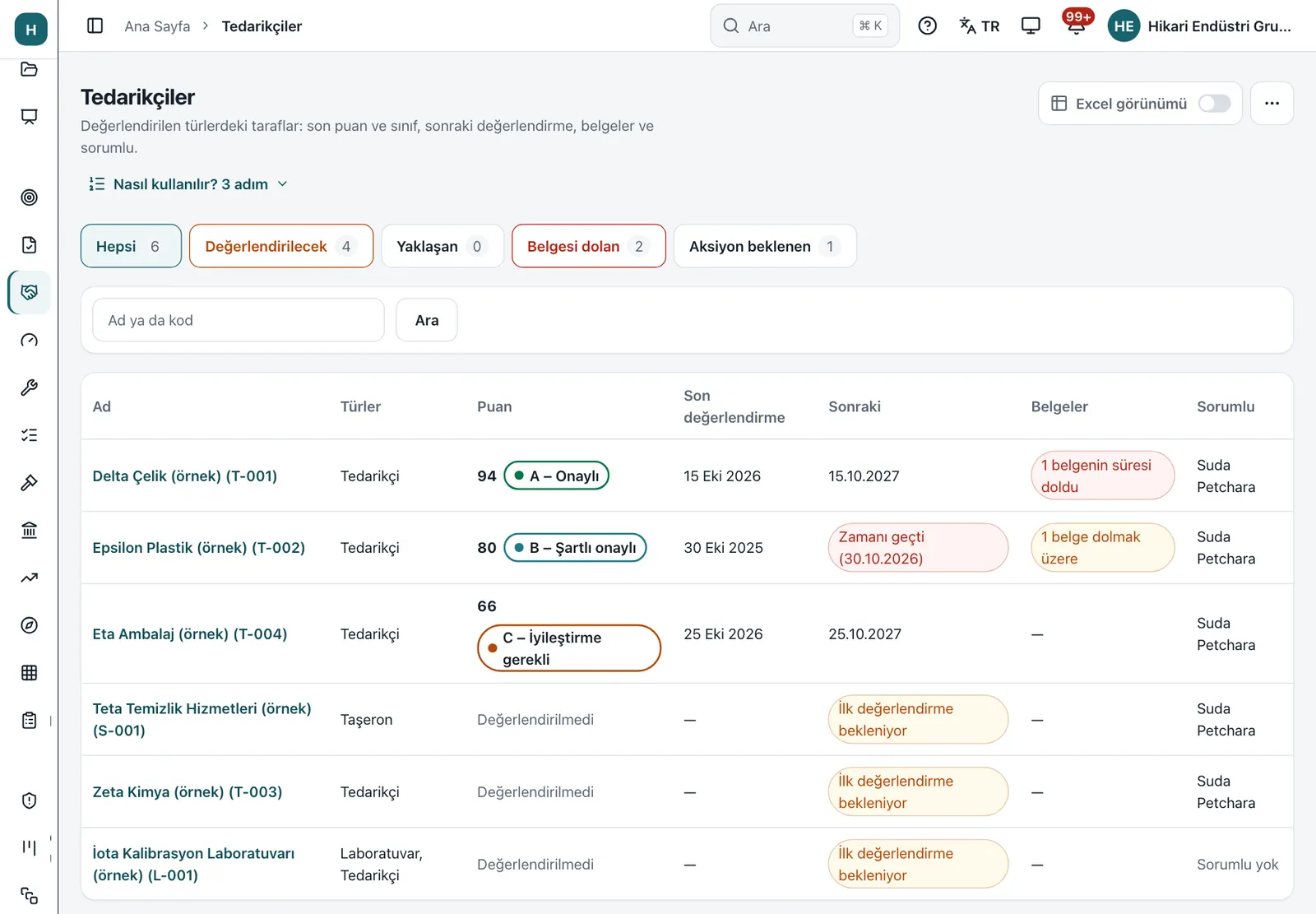
The criteria, their weights, the classes and the evaluation frequency are company settings. A criterion is scored by hand from one to five or counted by the system. Counted criteria are records in the period, expired documents, overdue actions or the on-site audit score. The scorecard shows how each criterion was calculated and the total formula. A saved evaluation is not changed; a correction is made with a new evaluation. A CAPA or an action can be opened and an on-site audit planned from the scorecard. The audit is done on the company's audit screen with a party audit template.
Terms
Sources
- ISO 9001:2026 Quality management systems, Requirements, International Organization for Standardization (ISO) (accessed 16 November 2026)
- ISO 19011:2026 Guidelines for auditing management systems, International Organization for Standardization (ISO) (accessed 16 November 2026)
- ISO 9000:2026 Quality management, Fundamentals and vocabulary, International Organization for Standardization (ISO) (accessed 16 November 2026)