
Strategy, Performance and Corporate Governance
Making management review useful
Tying the meeting where senior management evaluates the management system at planned intervals to numbers from records, decisions and tracked actions.
- Level:
- Practitioner
- Who it is for:
- Plant manager, Quality engineer, Strategy and planning lead
Definition
Management review is the meeting where senior management evaluates, at planned intervals, whether the management system is suitable, adequate and effective. Management system standards such as ISO 9001 and ISO 45001 require this review and list its inputs. Inputs include the status of earlier decisions, objectives, audit results, nonconformities and risks. In ISO 9001, outputs are decisions on improvement opportunities, the need for changes to the system and the need for resources. ISO 45001 lists further outputs and asks for the relevant outputs to be communicated to workers and their representatives.
When does it help?
- The meeting happens every year, but nobody remembers its decisions at the next one.
- When an auditor asks for the review inputs, you have to search through slide decks.
- Objectives, audit findings and risks need to be discussed at the same table.
When does it not help?
- Solving daily or weekly production problems; those belong in the floor meeting.
- Evaluating one person's performance; the review evaluates the system, not a person.
Step-by-step method
Write the frequency and the agenda
Put how many months apart the review is held and the agenda items into a template.
Set the input of each item
Write which record each item's number comes from; read the number from the record, not from a slide.
Close the period
Hold the meeting after the period ends and prepare the inputs with their end-of-period values; in the meeting, discuss what the number means.
Evaluate each item
Write in a sentence or two what the number says against the target.
Tie each decision to an owner
Give each decision a type, an owner and a due date; a decision without an owner is not followed.
Read the decisions at the next meeting
Make the status of earlier decisions the first item on the agenda.
Example scenario
The annual review at a foundry
At a foundry's annual review, customer complaints are discussed in the middle of the agenda. Two of the previous year's decisions have no owner written down, and nobody knows their status. The quality engineer makes earlier decisions the first agenda item for the next period. Each decision is written with its owner and due date, and their status is read halfway through the period.
A fictional example; the people, company and numbers are not real.
Common mistakes
- Turning the review into a slide show; numbers are discussed but no decision comes out.
- Writing a decision without an owner or a due date; it stays in the minutes.
- Changing the inputs after the meeting; the minutes no longer show the numbers of that day.
- Leaving earlier decisions off the agenda; the same problem becomes a new decision every year.
Lessons
- Preparing management review inputs
Tying agenda items to records, fixing the period and adding a short evaluation to each number.
1 min
- From a review decision to a tracked action
Writing a decision with its type, turning it into work followed with an owner and due date, and reading its status at the next meeting.
1 min
How does it work in Gemy on the floor?
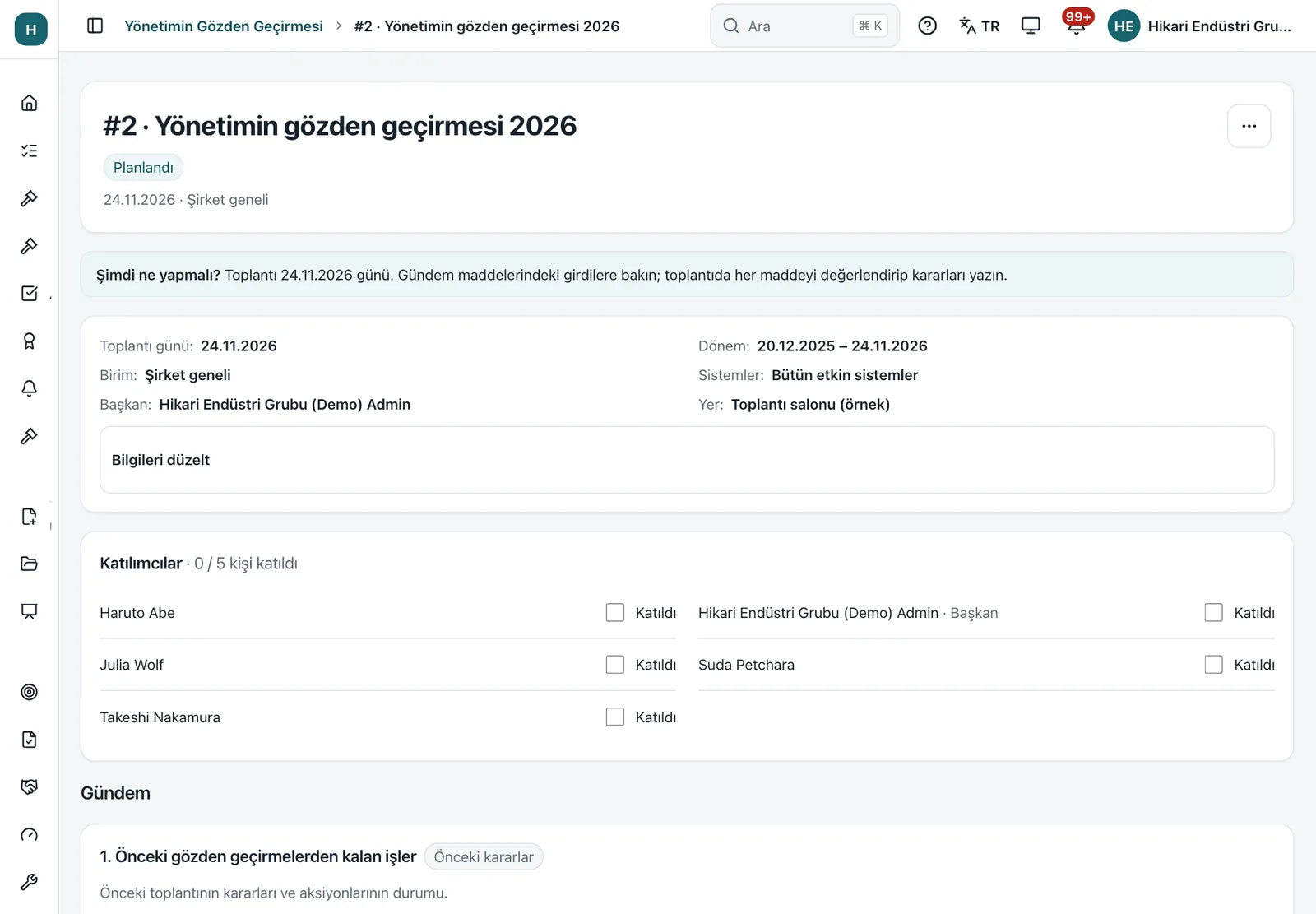
The agenda template and the review frequency are company data. The input of each agenda item is chosen: earlier decisions, actions, records, audits, risks, parties or indicators. The meeting page fills in the period's numbers by itself and shows how each was calculated. When an owner is chosen for a decision, an action is opened and followed in Actions. When the meeting is closed, the inputs are frozen at that day's values and the closed meeting cannot be changed. If minutes approval is chosen, the inputs are frozen when the meeting is sent for approval. If it is returned or rejected, they are calculated again.
Terms
Sources
- ISO 9001:2026 Quality management systems, Requirements, International Organization for Standardization (ISO) (accessed 16 November 2026)
- ISO 45001:2018 + Amd 1:2024, Occupational health and safety management systems, Requirements with guidance for use, International Organization for Standardization (ISO) (accessed 16 November 2026)
- Plan, Do, Check, Act (PDCA), Lean Enterprise Institute (accessed 16 November 2026)