
Quality, Audit and Compliance Management
Document control: versions, approval, reading
Making sure the right version of a procedure, instruction or form is approved, released, available where it is used and read.
- Level:
- Introductory
- Who it is for:
- Quality engineer, Shift supervisor, Plant manager
Definition
Document control is writing, reviewing, approving and releasing procedures, instructions and forms. The aim is that the person doing the job always has the valid version. ISO 9001 asks for this as the control of documented information. A document is identified, approved as fit for use, its changes are tracked and the old version is kept from being used by mistake. Documents from outside are identified and tracked too.
When does it help?
- Two different versions of the same instruction are going around on the floor.
- An instruction changed and you need to show who has read the change.
- An auditor asks when a document came into force and who approved it.
When does it not help?
- Records; a completed form or a measurement result is not revised, it is kept and protected.
- Personal working notes or a one-off announcement; these do not set how the job is done.
Step-by-step method
Set the types and numbering
Write down types such as procedure, instruction and form, and the numbering pattern of each type.
Give every document an owner
Write down the person and the unit responsible for its content and for keeping it current.
Review and approve
Before release, have someone who knows the job read the document; record its fitness with an approval.
Release and distribute
Set the effective date and who needs to read the document.
Track reading
See who of the people who need to read it has read it and who has not.
Withdraw the old version
When the new version comes into force, collect old printed copies from the floor; keep the old version in the archive.
Review at planned intervals
Set a review frequency for each document; if nothing changes, record that too.
Example scenario
An old version of a press setup instruction
At a metal forming plant the press setup instruction moves to a new revision. A printed copy of the old revision stays on the shift board, and the night shift sets up with the old value. The quality engineer removes the copies from the board and makes the instruction required reading. Reading status is followed in the master list; the shift supervisor explains the change on the floor to operators who have not read it.
A fictional example; the people, company and numbers are not real.
Common mistakes
- Forgetting a printed copy on the board; the new version is in the system, the old one stays at the machine.
- Releasing a revision without a change summary; the reader has to hunt for what changed.
- Treating a signature list as reading; a signature does not show the person understood the change.
- Forgetting documents from outside; a customer specification or a standard is renewed, the company works with the old one.
Lessons
- Document versions, approval and reading
Opening a revision with a change summary, taking it through approval, withdrawing the old version and seeing that it is read.
1 min
How does it work in Gemy on the floor?
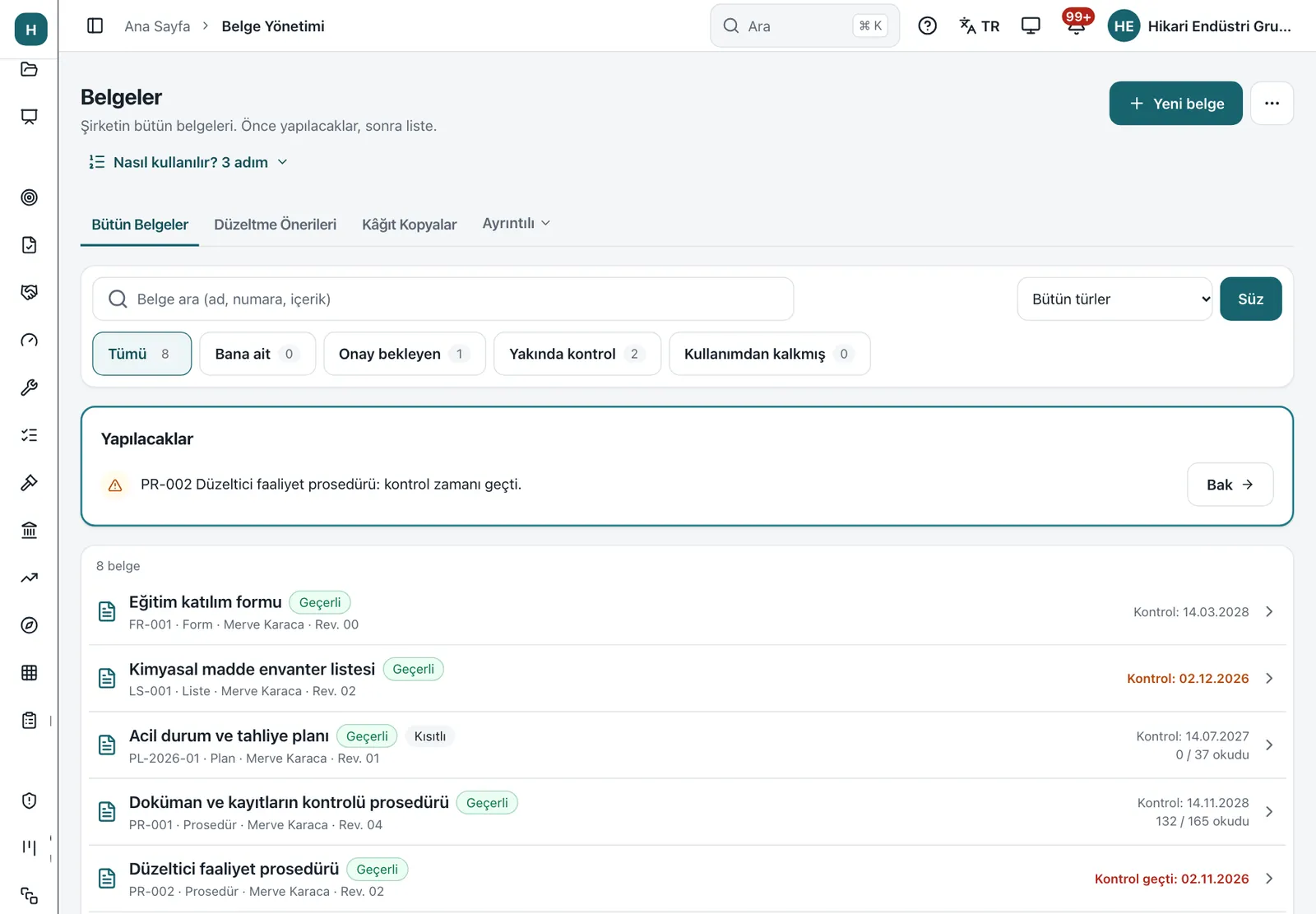
Document types, the numbering pattern, the section template and who releases a document are company data. A document is written in the system in sections or added as a file. A revision is approved through the company's approval flow; in a new revision, added and changed blocks show in red. When a new revision comes into force, the previous one becomes obsolete and stays in the archive. For a required-reading document, people on the distribution list get a reading task; the reading rate shows in the master list. When the review date gets close, the document owner is notified.
Terms
Sources
- ISO 9001:2026 Quality management systems, Requirements, International Organization for Standardization (ISO) (accessed 16 November 2026)
- ISO 9000:2026 Quality management, Fundamentals and vocabulary, International Organization for Standardization (ISO) (accessed 16 November 2026)