
Lean Manufacturing and Continuous Improvement
Kamishibai and layered audits
An audit where each management layer visits the floor at its own frequency and checks with a short card that the standard is applied.
- Level:
- Practitioner
- Who it is for:
- Shift supervisor, Quality engineer, Lean and OPEX specialist
Definition
Kamishibai is a visual method that runs short floor audits with cards and shows the result on a board. In LEI's description, the board ties when managers go to the floor and what they check to a schedule. In a layered process audit the same work is shared across management layers. Each layer checks at its own frequency whether the most important standards and controls are in place.
When does it help?
- You see a new standard being forgotten over time after an improvement.
- You need to be sure a critical control is done on every shift.
- You want to tie managers' regular floor visits to a schedule.
When does it not help?
- Evaluating a whole management system; that belongs in an internal audit.
- When a card question needs a measurement but no instrument is at hand; a card asks only what can be seen on the floor.
Step-by-step method
Choose the control points
List the standards and controls whose failure has a serious outcome.
Write the card
Put a few short questions on each card and how each is checked; add a photo of the right state.
Set the layers and frequency
Write which management layer goes to the floor and how often.
Answer on the floor
The auditor answers the card on site and writes what they saw for any item that is not met.
Open an action for each deviation
For every card with an unmet item, tie the correction to an owner and a due date.
Read the board
Discuss done, missed and flagged cards regularly.
Update the cards
Remove questions whose problem is solved or changed, and add new risks.
Example scenario
A torque check in a welding cell
In a metal parts plant, one of the welding cell's cards asks about the torque mark on the fixture bolts. In this example the company has set three layers: shift lead daily, department manager weekly, plant manager monthly. On the weekly audit the department manager sees that one bolt's mark has shifted and closes the card red. An action with a due date is opened for the maintenance lead, and the same card is asked again at the next audit.
A fictional example; the people, company and numbers are not real.
Common mistakes
- Turning the card into a long checklist; the audit loses its brevity and gets skipped.
- Always drawing the same card; the team prepares only for that question.
- Closing a card with an unmet item without an action; the same deviation shows up at the next audit.
- Not discussing missed audits; the schedule stays on paper.
Lessons
- Setting up Kamishibai cards and layers
Writing card questions short and visible, setting up layers and frequency, and reading the result on the board.
1 min
How does it work in Gemy on the floor?
Company switches onThis module is off in a new company; your administrator switches it on from the Features screen.
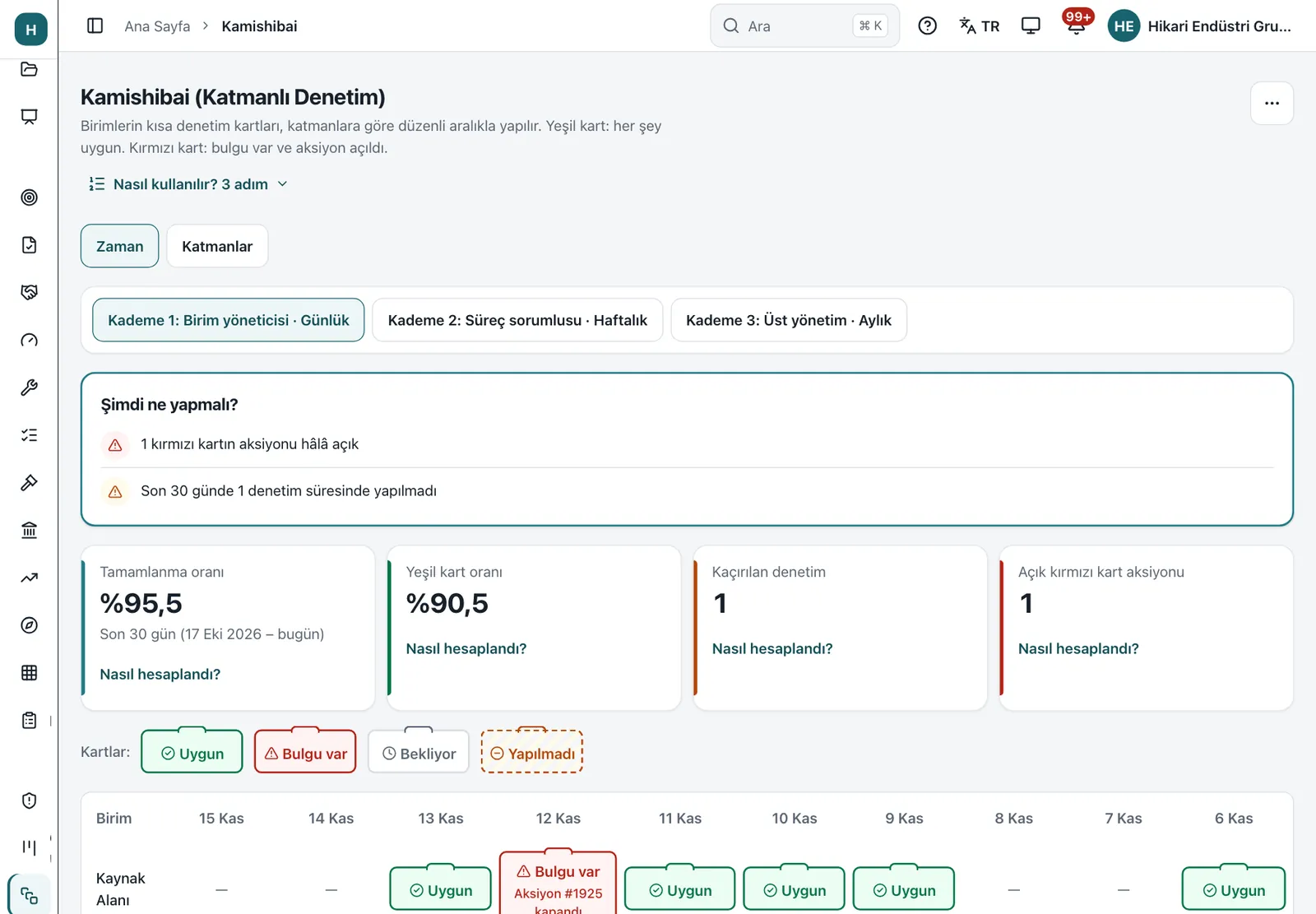
Layers, their frequency and the rule that finds the auditor are company settings; frequency is daily, weekly, every two weeks or monthly. The unit sets up its cards: up to seven questions, how each is checked and a reference photo. When an audit starts, a card whose last result was red and whose action is closed comes first. If there is none, a card not drawn in the last three audits is picked at random. If the company chooses, cards linked to an FMEA are drawn more often. If every item is met the card closes green; if one is not, it closes red. A red card cannot close without a new or open action linked to it. If the layer requires it, the audit does not start until the unit's QR code is scanned. The board shows completion, green cards, missed audits and open actions with their formulas.
Condition: Switched on by the company.
Terms
Sources
- Kamishibai Board, Lean Enterprise Institute (accessed 16 November 2026)
- Detail and Examples Promote More Effective Layered Process Audits (2014), Automotive Industry Action Group (AIAG) (accessed 16 November 2026)
- Standardized Work, Lean Enterprise Institute (accessed 16 November 2026)