
Health, Safety, Environment and Sustainability
Permit to work and preconditions
Starting high-risk work such as hot work, confined space entry or energy isolation only after preconditions and approval, and closing it safely.
- Level:
- Practitioner
- Who it is for:
- Safety specialist, Shift supervisor, Maintenance and calibration lead
Definition
A permit to work is a written system that states what high-risk work is done, when, and which plant parts are safe. An authorised person assesses the work and checks safety at each stage. The people doing the work sign to show they understand the risks and the precautions. In HSE's description, a permit does not replace the risk assessment; it applies it at the point of work. Issuing a permit does not by itself make a job safe. In Türkiye, Law 6331 makes risk assessment the employer's duty; the permit carries its controls to the floor.
When does it help?
- Hot work such as welding, cutting or grinding is going to be done where flammable material may be present.
- Someone is going to enter a confined space such as a tank, silo or pit.
- The job needs electrical, hydraulic or mechanical energy to be isolated, and several teams work in the same area.
When does it not help?
- Low-risk daily jobs with a known instruction and control; asking for a permit for every job turns it into routine paper.
- As a replacement for the risk assessment; the permit applies the controls the assessment found on the floor.
Step-by-step method
Define the job and the place
Write on the permit the job, the place, the equipment, and the start and end time.
Write the hazards and controls
Carry the controls from the risk assessment onto the permit; if a chemical is involved, add the controls from its safety data sheet.
Check the preconditions
Check each worker's competence, documents and protective equipment against the day the job will run.
Give approval to someone else
The person who requests the permit or does the job does not approve it; the approver is a competent authorised person.
Put the controls in place
Carry out controls such as isolation, gas testing and housekeeping on site before work starts, and tick them. The authorised person sees them on site before work starts.
Hand over at shift change
At the end of a shift, leave unfinished work safe and hand it over to the next shift with clear instructions.
Close the permit
When the job is done, see that the area is left safe, hand the plant back to operations and close the permit.
Example scenario
Repairing a scraper inside a silo
At a feed mill the maintenance team is going to enter a storage silo to repair a scraper. One worker's confined space training expires before the work day, so the permit is not approved and a worker with valid training is added. Work starts after isolation, gas testing, a standby person outside and rescue equipment are ticked; gas testing continues during the job. At the end the area is left safe and the permit is closed.
A fictional example; the people, company and numbers are not real.
Common mistakes
- Turning the permit into a signing formality; the control is ticked on paper but not done on the floor.
- Keeping linked permits apart; two teams work on the same equipment without knowing about each other's job.
- Piling permits up at shift start; the approver signs without reading.
- Skipping the close-out; operations start the plant without knowing whether maintenance has finished.
Lessons
- Permit preconditions and close-out
Telling person and job preconditions apart, giving approval and handover to the right person, and closing the permit safely.
1 min
- Permit to work field guide: issue to close-out
Preparing one permit, putting controls in place on the floor, the handover and close-out steps, and what you have at the end.
Field guide
How does it work in Gemy on the floor?
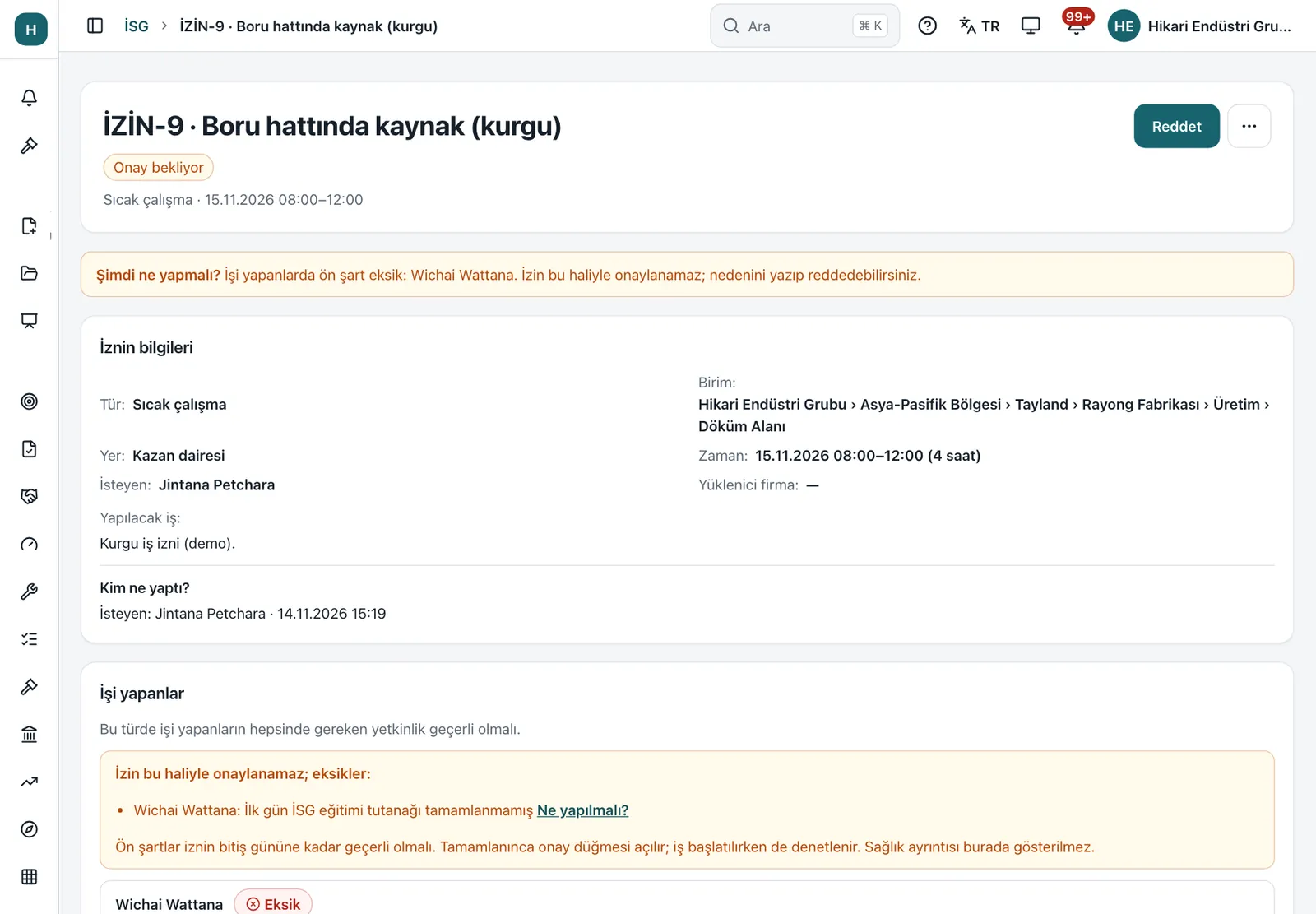
Permit types, the list of controls, the longest duration and the preconditions are company data. A competence, personal protective equipment, a personnel document, basic EHS training or a restriction label can be chosen as a precondition. If a precondition is not valid for each worker until the end date, the permit is not approved; it is checked again at start. If the company allows it for a type, an authorised person outside the job can pass a gap by writing a reason. If no approval flow is linked, the permit is approved with one click; the requester and the workers cannot make this decision. Work cannot be started until the required controls are ticked. The person who closes the permit confirms that the area was left safe. A reminder goes out as the end time approaches and when the permit has expired without being closed.
Terms
Sources
- Permit to work systems, Health and Safety Executive (HSE) (accessed 16 November 2026)
- HSG250 Guidance on permit-to-work systems: A guide for the petroleum, chemical and allied industries (2005), Health and Safety Executive (HSE) (accessed 16 November 2026)
- 6331 sayılı İş Sağlığı ve Güvenliği Kanunu. Opens in a new tab (PDF), T.C. Cumhurbaşkanlığı Mevzuat Bilgi Sistemi (accessed 16 November 2026)