
Strategy, Performance and Corporate Governance
Enterprise risk and opportunity register
Scoring threats and opportunities to the company's objectives in a register, reading them against risk appetite and giving each an owner and a control.
- Level:
- Practitioner
- Who it is for:
- Strategy and planning lead, Plant manager, Quality engineer
Definition
Risk-based thinking means thinking ahead about what could go wrong and which opportunity could be missed, and planning controls. An enterprise risk and opportunity register does this at company scale; it treats a market, a supplier or an investment as threats and opportunities. ISO 31000 describes risk as the effect of uncertainty on objectives; the effect can be positive or negative. COSO asks for risk to be considered both when strategy is set and when performance is managed.
When does it help?
- You want to see what could upset the objectives while the yearly plan or budget is prepared.
- A customer requirement, a regulation or a market has changed and you need to assess its effect.
- You are preparing the risk and opportunity input for management review.
When does it not help?
- Scoring a hazard on a machine or in a job; that belongs in the workplace safety risk assessment.
- Predicting the outcome of a decision for certain; the register ranks uncertainty, it does not know the future.
Step-by-step method
Choose the register's scope
Write which unit or subject the register covers and whether it holds threats, opportunities or both.
Write the scale and the appetite
Before scoring, set the meaning of the likelihood and impact steps and the highest level that is accepted.
Draw risks from their sources
Start from the objectives, the expectations of interested parties and the internal and external issues.
Score
Score today's situation first, and score the after-controls situation separately once a control is in place.
Tie a control to what exceeds the appetite
For each risk above the appetite, write an owner, a control and a due date.
Give opportunities an owner too
An opportunity also needs action; an opportunity with no owner and no first step is missed.
Review at planned intervals
Read the register again at set intervals and after a major change; take the result to management review.
Example scenario
A raw material tied to one supplier
At a packaging maker the strategy team opens the enterprise risk register before the yearly plan. The main raw material comes from a single supplier; a supply interruption is written as a threat and comes out above the appetite. Approval of a second supplier is started as the control, with its owner and due date written down. In the same session a customer's request for recycled material goes into the register as an opportunity.
A fictional example; the people, company and numbers are not real.
Common mistakes
- Writing only threats in the register; opportunities stay somewhere else and nobody follows them.
- Calling a risk high without defining the appetite; if nobody knows what is accepted, no decision can be made.
- Leaving a risk without an owner; a row with a score but a control that is nobody's job does not change.
- Filling in the register once a year and closing it; when the market or a customer changes, the register goes stale.
How does it work in Gemy on the floor?
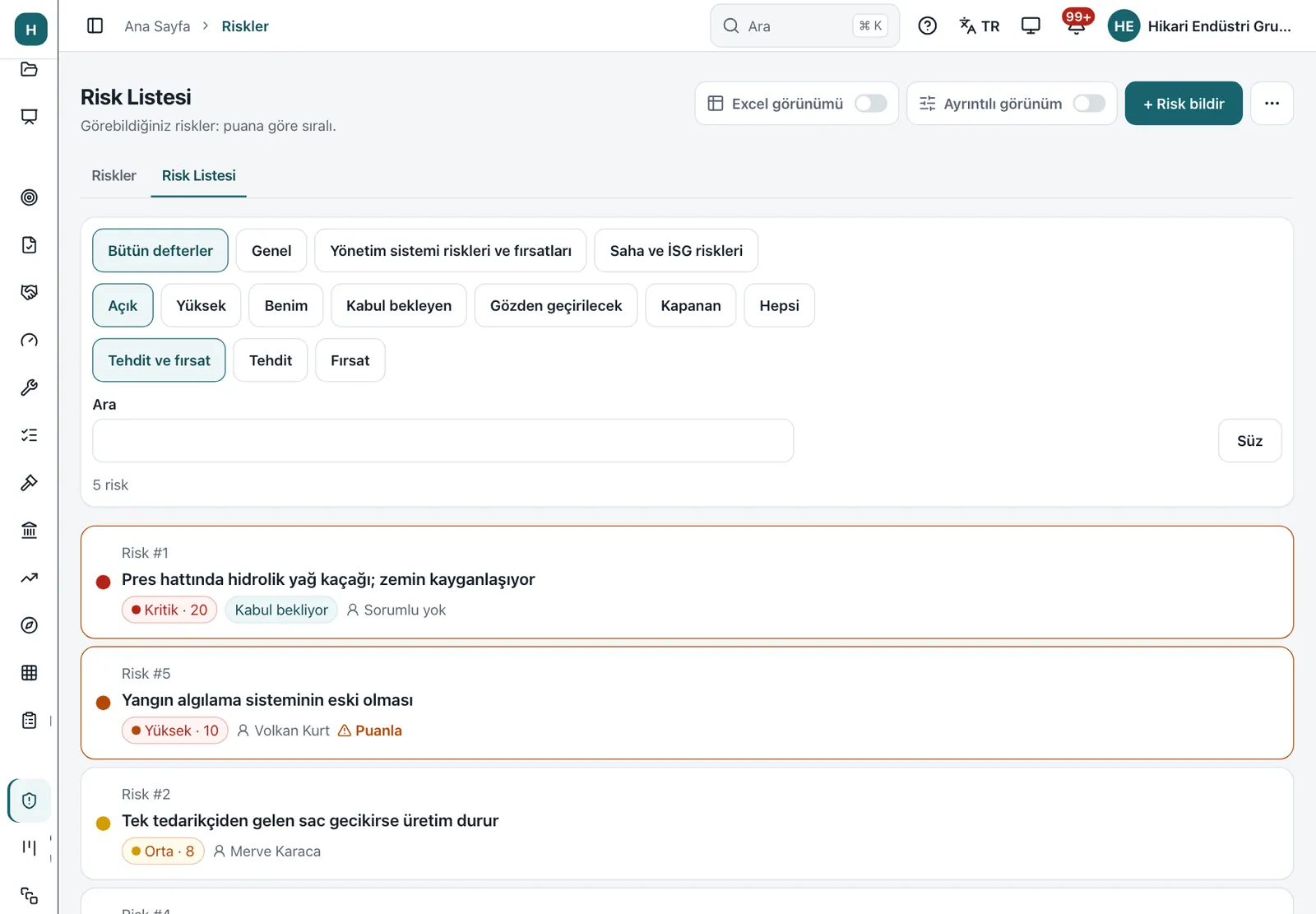
The company keeps several risk registers; each register has its own method, scale, categories and appetite. A register allows threats, opportunities or both, and it can be linked to management systems. Risk appetite is written as a level, not as a score; a category can replace the register's general appetite with its own. An interested party expectation can be chosen on the risk form. The party's card shows how many linked risks and opportunities there are, as far as the viewer is allowed to see them. An opportunity arising from a risk is opened from the risk page, or an existing opportunity is linked to it. A control opened from a risk is followed as a central action.
Terms
Sources
- ISO 31000:2018 Risk management, Guidelines, International Organization for Standardization (ISO) (accessed 16 November 2026)
- Enterprise Risk Management, Committee of Sponsoring Organizations of the Treadway Commission (COSO) (accessed 16 November 2026)
- ISO 9001:2026 Quality management systems, Requirements, International Organization for Standardization (ISO) (accessed 16 November 2026)