
Quality, Audit and Compliance Management
Internal audit programme and findings
An organisation auditing its own management system with its own auditors under a planned programme, writing findings with evidence and linking them to fixes.
- Level:
- Practitioner
- Who it is for:
- Quality engineer, Plant manager
Definition
An internal audit is an organisation examining, with its own auditors and at planned intervals, whether its management system works. Management system standards such as ISO 9001 require this audit and an audit programme. ISO 19011 gives guidance on managing the programme and conducting the audit. A finding is the result of comparing the evidence collected with the audit criteria. An internal audit is separate from a certification audit.
When does it help?
- There is a yearly audit calendar, but nobody has written why one process is audited before another.
- Findings are written, but their corrections are not followed.
- You want to see the system's weak points yourself before an external audit.
When does it not help?
- Replacing the certification audit; that audit is carried out by an accredited certification body.
- Evaluating one employee's performance; an audit examines the system, not the person.
Step-by-step method
Write the aim of the programme
Write which systems and which period the programme covers.
Set priority by risk
Put processes that had problems, changed or have serious outcomes at the front of the programme.
Choose the auditor
Auditors should not be involved in the work they examine. In a small organisation, if they must audit their own unit, write down why and set their competence in advance.
Plan the audit
Share the scope, the criteria and the people to interview with the audited unit before the audit.
Collect evidence
Look at records, watch the work, ask people; write the evidence for every finding.
Classify the finding
Choose one of the company's finding classes and tie a nonconformity to corrective action.
Feed the result back into the programme
Use the results of findings when you set the priority of the next programme.
Example scenario
Rebuilding the programme at a plastic injection plant
At a plastic injection plant the internal audit programme has run in the same order for years. The quality engineer looks at last year's customer complaints and sees that most came after mould changes. The mould change process is moved to the front of the programme, and an auditor from outside maintenance is chosen. The audit writes as a finding that first-part approval was not recorded on two shifts, and ties it to corrective action.
A fictional example; the people, company and numbers are not real.
Common mistakes
- Auditing every process every year in the same order; the programme ignores risk.
- Writing a finding without evidence; the audited unit rejects it and the argument drags on.
- Choosing an auditor who is involved in the work examined; no independent view remains.
- Closing a nonconformity without correcting it; the same finding comes back at the next audit.
Lessons
- Internal audit programme and writing findings
Ordering the programme by risk, keeping the auditor independent, and writing a finding with criterion, evidence and gap.
1 min
- Internal audit field guide: one audit day
Preparing one internal audit, the steps for collecting evidence on the floor and what you should have at the end of it.
Field guide
How does it work in Gemy on the floor?
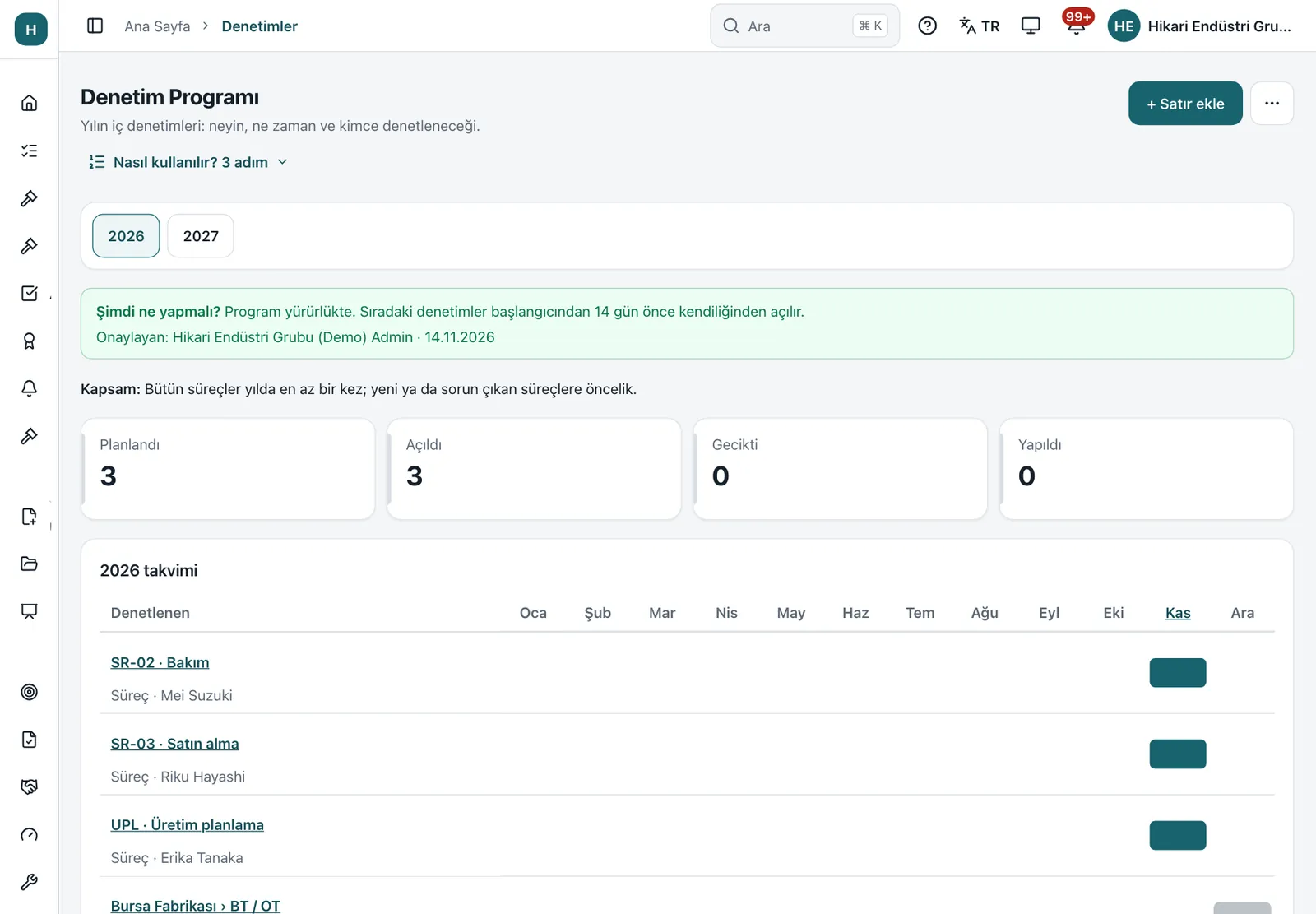
Each row of the yearly audit programme says what is audited, when and by whom. The row takes a unit or a process, the system clauses to look at, an audit template and a period. The programme is approved; if it changes after approval, it needs approval again. In an approved programme, the audit of a row whose period is near opens by itself overnight; how many days ahead is a company setting. If the auditor works in the audited unit, manages it or owns the process, the screen shows this before saving. The company chooses whether to block it, ask for a reason or not check. The coverage section lists processes with no row in the programme and clauses nobody looks at. Finding classes are the company's list, and a CAPA can be opened from a finding. You set the priority by risk; the programme does not calculate it.
Terms
Sources
- ISO 9001 Auditing Practices Group, Guidance on: Internal Audits (Edition 1, Amd 1, 2020). Opens in a new tab (PDF), ISO/TC 176 and International Accreditation Forum (IAF) (accessed 16 November 2026)
- ISO 19011:2026 Guidelines for auditing management systems, International Organization for Standardization (ISO) (accessed 16 November 2026)
- ISO 9001:2026 Quality management systems, Requirements, International Organization for Standardization (ISO) (accessed 16 November 2026)